Gold IRA vs Traditional IRA 2026: Which Is Better for Retirement?
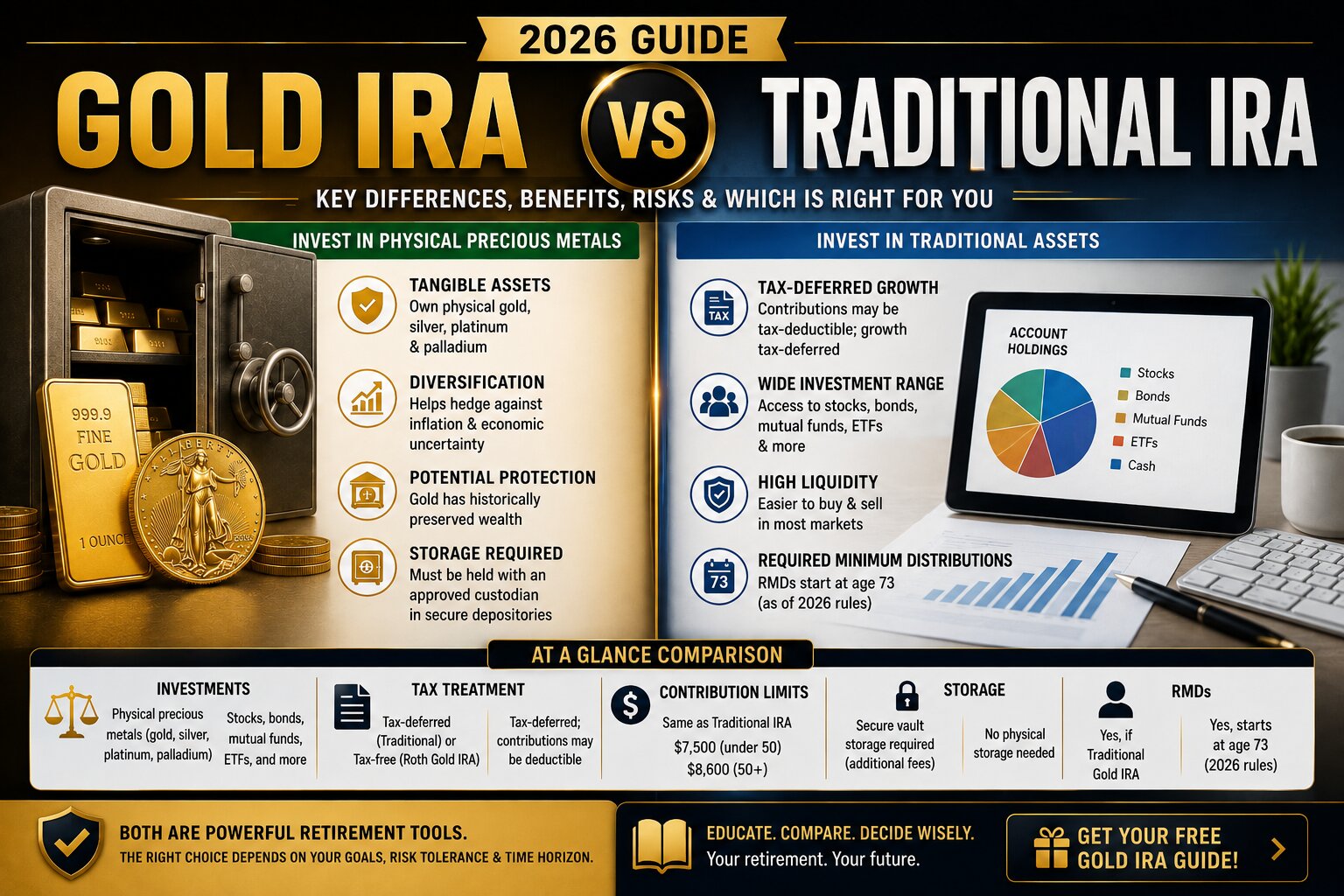
A Gold IRA vs Traditional IRA comparison can help retirement savers understand two very different approaches to investing inside an individual retirement account.
A conventional traditional IRA commonly holds investments such as stocks, bonds, mutual funds and exchange-traded funds. A Gold IRA is generally a self-directed IRA designed to hold certain qualifying physical precious metals.
But there is an important distinction that investors should understand from the start: a Gold IRA can itself be a traditional IRA.
“Gold IRA” generally describes the type of assets and self-directed structure being used, while “traditional IRA” describes the tax treatment of the account.
Therefore, when investors search for Gold IRA vs Traditional IRA, they are usually comparing a self-directed traditional IRA holding physical precious metals with a conventional traditional IRA holding securities such as stocks, bonds and funds.
This Gold IRA vs Traditional IRA 2026 guide compares investment choices, taxes, contribution limits, fees, storage, liquidity, RMDs, diversification and other important retirement considerations.
Gold IRA vs Traditional IRA: Quick Comparison
| Feature | Gold IRA | Conventional Traditional IRA |
|---|---|---|
| Typical Investments | Qualifying physical precious metals | Stocks, bonds, mutual funds, ETFs and other permitted investments |
| Tax Structure | Can use traditional or Roth structure | Traditional IRA tax structure |
| 2026 Contribution Limit | $7,500 combined IRA limit; $8,600 age 50+ | $7,500 combined IRA limit; $8,600 age 50+ |
| Potential Deduction | Possible when structured as traditional IRA, subject to applicable rules | Contributions may be deductible depending on circumstances |
| Physical Storage | Applicable custody requirements for qualifying bullion | Generally not applicable to conventional securities |
| Income | Physical gold pays no dividends or interest | Investments may generate dividends or interest |
| RMDs | Traditional Gold IRA generally subject to traditional IRA RMD rules | Generally begin at age 73 under current rules |
| Fees | May include custodian, storage and dealer costs | Often lower, depending on brokerage and investments |
| Liquidity | Physical metals must generally be sold or distributed through the IRA process | Publicly traded securities can generally be sold relatively quickly |
What Is a Gold IRA?
To understand Gold IRA vs Traditional IRA, we first need to define a Gold IRA correctly.
A Gold IRA is a commonly used term for a self-directed individual retirement account that can hold certain qualifying physical precious metals.
Depending on the structure, qualifying metals may include certain forms of:
- Gold
- Silver
- Platinum
- Palladium
Federal IRA rules generally restrict investments in collectibles, including metals and coins, but provide exceptions for certain qualifying coins and bullion.
A Gold IRA also generally requires specialized administration because the account holds physical assets rather than only conventional securities.
If you are new to precious-metals IRAs, read our What Is a Gold IRA? guide first.
What Is a Traditional IRA?
A traditional IRA is an individual retirement arrangement that can provide tax-deferred retirement investing.
Depending on the taxpayer’s income, filing status and participation in an employer-sponsored retirement plan, contributions may be fully deductible, partially deductible or nondeductible.
Investment earnings inside the account generally are not taxed annually while they remain in the IRA.
Taxable distributions from a traditional IRA are generally included in income when withdrawn.
Traditional IRAs at mainstream brokerage firms commonly provide access to investments such as stocks, bonds, mutual funds, ETFs and cash-equivalent investments.
Gold IRA vs Traditional IRA: The Key Difference
The central difference in a typical Gold IRA vs Traditional IRA comparison is the type of investments held inside the account.
Traditional Gold IRA: uses the traditional IRA tax structure but is self-directed and designed to hold qualifying physical precious metals.
In other words, the comparison is primarily about investment strategy and account administration, not necessarily two different tax systems.
Can a Gold IRA Be a Traditional IRA?
Yes.
In fact, many Gold IRAs are structured as traditional self-directed IRAs.
That means the account can generally receive tax-deferred retirement assets through eligible transfers or rollovers while holding qualifying physical precious metals.
A Gold IRA can also potentially use a Roth structure.
This is why investors should separate two decisions:
- What tax structure do I want?
- What assets do I want my IRA to hold?
Understanding this distinction makes the Gold IRA vs Traditional IRA comparison much clearer.
Gold IRA vs Traditional IRA Tax Treatment
If the Gold IRA is structured as a traditional IRA, its fundamental tax treatment generally follows traditional IRA rules.
That means the tax structure itself may be very similar.
Traditional Gold IRA
Eligible contributions may potentially be deductible depending on the investor’s circumstances.
Investment gains generally remain tax-deferred while inside the IRA.
Taxable distributions are generally included in income when withdrawn.
Conventional Traditional IRA
The same basic traditional IRA tax principles apply.
The main difference is that the account commonly holds conventional investments instead of qualifying physical precious metals.
The tax treatment is therefore not necessarily the deciding factor between the two.
Gold IRA vs Traditional IRA Contribution Limits in 2026
A common misconception is that opening a Gold IRA gives an investor a second independent IRA contribution allowance.
It does not.
For 2026, the total regular contribution limit across an individual’s traditional and Roth IRAs is generally:
2026 IRA Contribution Limits
Under age 50: $7,500
Age 50 or older: $8,600
The $8,600 limit includes the $1,100 catch-up contribution available to eligible individuals age 50 or older.
These limits are aggregated across your IRAs.
For example, owning both a conventional traditional IRA and a traditional Gold IRA does not automatically allow you to contribute $7,500 to each.
Eligible rollover contributions are treated differently and generally do not count toward the normal annual IRA contribution limit.
Gold IRA vs Traditional IRA Investment Options
Investment selection is one of the biggest practical differences in the Gold IRA vs Traditional IRA comparison.
Typical Gold IRA Investments
A precious-metals self-directed IRA may hold certain qualifying:
- Gold bullion bars
- Gold coins
- Silver bullion
- Platinum bullion
- Palladium bullion
However, not every precious-metal coin or bar qualifies for IRA ownership.
Typical Conventional Traditional IRA Investments
Depending on the custodian or brokerage, a conventional IRA may offer:
- Individual stocks
- Government bonds
- Corporate bonds
- Mutual funds
- Index funds
- ETFs
- Money-market funds
- Certificates of deposit
- Other permitted investments
This can make conventional IRAs particularly convenient for building diversified portfolios from publicly traded investments.
Gold IRA vs Traditional IRA for Diversification
Diversification is one of the primary reasons some investors research a Gold IRA.
A conventional traditional IRA can already be diversified across many companies, industries, countries and fixed-income investments.
But those investments remain primarily financial securities.
Physical precious metals provide exposure to a different asset class.
Some retirement savers therefore consider gold as one component of a broader portfolio rather than a replacement for stocks and bonds.
For a broader analysis, see our Gold IRA Pros and Cons.
Gold IRA vs Traditional IRA Growth Potential
Neither type of IRA guarantees better returns.
A traditional IRA is only an account structure. Its performance depends on the assets held inside it.
A conventional IRA invested heavily in equities may benefit from corporate earnings growth, dividends and long-term capital appreciation.
Physical gold operates differently.
Gold does not represent ownership in a company and does not generate corporate profits.
Its return primarily depends on changes in the market value of the metal after accounting for transaction costs, spreads and ongoing account expenses.
Therefore, a Gold IRA vs Traditional IRA decision should not be based on the assumption that either asset category will always outperform.
Gold IRA vs Traditional IRA: Dividends and Income
Physical gold itself produces no income.
It does not pay:
- Dividends
- Interest
- Rent
- Corporate earnings distributions
Many conventional IRA investments can generate income.
Stocks may pay dividends, while bonds and other fixed-income investments may pay interest.
Those payments can potentially be reinvested within the IRA and contribute to long-term compounding.
This is an important consideration for investors comparing Gold IRA vs Traditional IRA for long-term growth.
Gold IRA vs Traditional IRA Fees
Cost is one area where the two strategies can differ substantially.
Possible Gold IRA Costs
- Account setup fee
- Annual custodian fee
- Administration fee
- Storage fee
- Precious-metal dealer spread
- Transaction charges
- Shipping or handling charges where applicable
Possible Conventional IRA Costs
- Fund expense ratios
- Advisory fees
- Trading fees where applicable
- Account fees depending on provider
Many low-cost brokerage IRAs can have relatively low ongoing expenses, particularly when invested in low-cost index funds.
A physical Gold IRA generally involves additional custody and storage infrastructure.
Read our Gold IRA Fees Explained before opening a precious-metals IRA.
Considering Physical Gold for Your Retirement?
Before moving retirement savings, learn how a Gold IRA works, what fees may apply and how physical precious metals differ from conventional IRA investments. Augusta offers a free educational Gold IRA guide you can review as part of your research.
Affiliate link • Gold IRA Guide HQ may receive compensation from qualifying referrals.
Gold IRA vs Traditional IRA Storage Requirements
Storage is one of the most obvious differences between physical precious metals and conventional securities.
Stocks, bonds and funds do not require a physical precious-metals depository.
Physical bullion does.
Federal IRA rules generally treat metals as collectibles but provide an exception for certain qualifying bullion when applicable requirements are satisfied.
Qualifying bullion under that exception must be in the physical possession of a bank or an approved non-bank trustee.
This means investors should not assume they can purchase Gold IRA bullion and simply keep it in a home safe for personal possession.
Our Gold IRA Storage Rules guide explains this issue in greater detail.
Gold IRA vs Traditional IRA Liquidity
Liquidity matters because retirement investors may eventually need to sell assets for distributions, portfolio changes or required minimum distributions.
Publicly traded stocks and ETFs can generally be sold electronically during market hours.
Physical gold liquidation typically involves additional steps.
An investor may need to coordinate with the IRA custodian and precious-metals dealer to sell the metals and return cash proceeds to the IRA.
Before opening a Gold IRA, ask:
- How does liquidation work?
- Who buys the metals?
- How is the repurchase price calculated?
- Are liquidation fees charged?
- How long does the process typically take?
Gold IRA vs Traditional IRA Required Minimum Distributions
If a Gold IRA is structured as a traditional IRA, it generally remains subject to traditional IRA required minimum distribution rules.
Under current federal rules, traditional IRA owners generally must begin taking RMDs for the year they reach age 73.
The first RMD can generally be delayed until April 1 of the following year, but doing so can result in two taxable RMDs occurring during that following calendar year.
How Do RMDs Work With Physical Gold?
Physical assets can make RMD planning more complicated than holding cash or publicly traded securities.
An investor may potentially need to sell enough precious metals to generate cash for a distribution or arrange an appropriate in-kind distribution.
Once metal is distributed from the IRA, tax consequences can apply according to the account and distribution rules.
This is one reason investors approaching RMD age should consider liquidity when deciding how much of a traditional IRA to allocate to physical precious metals.
Gold IRA vs Traditional IRA Rollover Options
Many Gold IRAs are funded through transfers or rollovers rather than only through new annual contributions.
Eligible retirement assets may potentially be moved into an appropriate self-directed IRA while maintaining retirement-account status when the rollover is properly completed.
However, rollover eligibility and procedures depend on the account being moved.
Investors should understand whether they are completing:
- A trustee-to-trustee transfer
- A direct rollover
- An indirect rollover
- A Roth conversion
These transactions are not identical.
Read our complete Gold IRA Rollover Guide before moving retirement assets.
Gold IRA vs Traditional IRA for Inflation
Some investors consider physical gold because they want retirement assets that may behave differently from stocks, bonds and cash during periods of inflation or economic uncertainty.
Gold has historically been viewed by many investors as a potential store of value.
However, that does not mean gold perfectly tracks inflation or automatically rises whenever consumer prices increase.
A conventional traditional IRA can also hold investments that may potentially respond differently to inflation, including equities, inflation-protected securities and other assets.
Therefore, inflation concerns alone should not determine the entire Gold IRA vs Traditional IRA decision.
Gold IRA vs Traditional IRA for Market Downturns
One reason investors diversify is that different asset classes can behave differently during periods of market stress.
A conventional IRA heavily invested in stocks can experience significant short-term losses during equity bear markets.
Gold may sometimes behave differently from stocks, but it is not guaranteed to increase when equities decline.
Gold prices can also experience substantial volatility.
The objective of diversification is generally not to predict exactly which asset will outperform next.
It is to avoid relying entirely on one source of return.
Gold IRA vs Traditional IRA for Long-Term Growth
Long investment horizons can make compounding particularly important.
Stocks represent ownership interests in businesses that can potentially increase earnings, reinvest capital and distribute dividends.
Physical gold has no comparable internal compounding mechanism.
Its value depends primarily on what buyers are willing to pay for the metal.
That difference does not make gold inherently better or worse.
It means the assets may serve different purposes in a retirement portfolio.
Gold IRA vs Traditional IRA: Which Is Simpler?
For most investors, a conventional brokerage IRA is simpler to administer.
Opening an account, buying a diversified fund and monitoring investments can often be done electronically.
Physical Gold IRAs generally involve additional parties and processes, potentially including:
- A self-directed IRA custodian
- A precious-metals dealer
- A qualified storage arrangement
- Physical metal purchases
- Additional account documentation
Investors considering physical precious metals should be comfortable with this additional complexity.
Gold IRA vs Traditional IRA: Which Is More Flexible?
A conventional traditional IRA at a large brokerage will generally offer greater flexibility among publicly traded investments.
An investor can potentially move among stocks, bonds, ETFs and funds relatively easily.
A precious-metals IRA is more specialized.
Its purpose is generally to provide retirement-account access to qualifying physical metals.
Therefore, investors who want maximum investment flexibility may prefer keeping a substantial portion of their retirement savings in conventional accounts even if they decide to add some physical gold exposure.
Can You Have Both a Gold IRA and Traditional IRA?
Yes.
Investors can potentially maintain multiple IRA accounts.
For example, an individual might maintain:
- A conventional traditional IRA holding stocks and funds
- A self-directed traditional Gold IRA holding qualifying precious metals
- A Roth IRA for additional tax diversification
However, owning several accounts does not multiply the normal annual IRA contribution limit.
The 2026 contribution limit generally applies to total contributions across traditional and Roth IRAs.
Gold IRA vs Traditional IRA Pros and Cons
| Option | Potential Advantages | Potential Drawbacks |
|---|---|---|
| Gold IRA |
Physical precious-metal exposure Tangible assets Alternative diversification Can potentially receive eligible retirement rollovers |
Storage costs Custodian costs Dealer spreads No dividends or interest More complex administration |
| Conventional Traditional IRA |
Broad investment selection Potentially low costs High liquidity for many securities Access to dividend and interest-producing investments Simple brokerage administration |
Market volatility Investment losses remain possible RMD requirements Taxable withdrawals generally apply |
Who Might Consider a Gold IRA?
A Gold IRA May Be Worth Researching If You:
- Specifically want qualifying physical precious metals in retirement savings
- Already have substantial exposure to conventional financial assets
- Want another source of portfolio diversification
- Understand precious-metal pricing and dealer spreads
- Are comfortable paying storage and custodian costs
- Have a long-term retirement strategy rather than a short-term trading goal
Who Might Prefer a Conventional Traditional IRA?
A Conventional IRA May Appeal More If You:
- Want broad investment choices
- Prefer simple account management
- Prioritize low investment costs
- Want easy access to stocks, bonds and funds
- Want investments capable of generating dividends or interest
- Do not specifically need physical precious-metal exposure
Could Using Both Make More Sense?
For some investors, the more useful question is not whether to choose Gold IRA vs Traditional IRA exclusively.
It is whether physical precious metals deserve a place alongside conventional retirement investments.
For example, an investor could maintain most retirement assets in diversified stocks and bonds while allocating a smaller portion to qualifying physical precious metals through a self-directed IRA.
This can preserve exposure to long-term business growth while adding an alternative physical asset.
The appropriate allocation, if any, depends on individual goals, risk tolerance, time horizon, tax circumstances and overall financial position.
Gold IRA vs Traditional IRA for Beginners
Beginners should pay particular attention to complexity and costs.
A conventional traditional IRA can often be opened at a brokerage and invested in diversified funds with relatively little administrative complexity.
A physical Gold IRA introduces additional considerations:
- Which metals qualify?
- Who is the custodian?
- Where are the metals stored?
- How much is the dealer markup?
- What are the annual fees?
- How does liquidation work?
- What are the applicable tax rules?
New precious-metals investors can also read our Best Gold IRA for Beginners guide.
Questions to Ask Before Opening a Gold IRA
Gold IRA Due-Diligence Checklist
- Who will serve as my IRA custodian?
- Where will my precious metals be stored?
- What are the setup fees?
- What are the annual custodian fees?
- What are the storage fees?
- What metals are being recommended?
- Are those metals eligible for IRA ownership?
- What price am I paying?
- What is the dealer’s current repurchase price?
- What is the buy/sell spread?
- How does liquidation work?
- Are there additional transaction fees?
- What happens when RMDs begin?
- What portion of my overall retirement savings would be in metals?
Common Gold IRA vs Traditional IRA Mistakes
Mistake #1: Assuming a Gold IRA Has Different Contribution Limits
A Gold IRA does not create an additional annual IRA contribution allowance.
Mistake #2: Assuming Gold Cannot Lose Value
Gold prices fluctuate and investment losses are possible.
Mistake #3: Ignoring Precious-Metal Spreads
The difference between the price you pay and the amount a dealer would currently pay to repurchase the metal can materially affect returns.
Mistake #4: Ignoring Storage Rules
IRA-owned qualifying bullion is subject to specific custody requirements.
Mistake #5: Moving an Entire Retirement Portfolio Into Gold
Replacing one concentrated portfolio with another can undermine the purpose of diversification.
Mistake #6: Choosing a Company Based Only on a Promotion
Compare total costs, product pricing, custodian arrangements and service rather than focusing only on “free gold” or similar promotions.
Our Gold IRA Scams to Avoid guide covers additional warning signs.
Learn How a Gold IRA Works Before You Decide
If you are comparing a physical Gold IRA with conventional retirement investments, start by understanding the rollover process, storage rules, fees and precious-metal pricing. Augusta’s free educational guide can help with that research.
Affiliate disclosure: Gold IRA Guide HQ may receive compensation from qualifying referrals.
Gold IRA vs Traditional IRA 2026: Final Verdict
The most important lesson from this Gold IRA vs Traditional IRA 2026 comparison is that a Gold IRA and traditional IRA are not necessarily opposing account types.
A Gold IRA can itself use a traditional IRA structure.
The real difference is usually what the retirement account owns.
A conventional traditional IRA commonly provides convenient access to stocks, bonds, mutual funds and ETFs. These investments can offer liquidity, broad diversification and the potential for dividends, interest and long-term compounding.
A physical Gold IRA provides exposure to qualifying precious metals held within a self-directed retirement structure.
That can provide another form of diversification, but it also introduces additional costs, physical storage requirements, dealer spreads and administrative complexity.
For many retirement savers, therefore, the decision does not have to be Gold IRA vs Traditional IRA in an all-or-nothing sense.
A more useful question may be whether physical precious metals deserve an appropriate place alongside conventional investments within an overall retirement strategy.
Before making that decision, understand the fees, storage arrangements, tax rules, rollover procedures and risks involved.
Continue your research with our What Is a Gold IRA?, Gold IRA Rollover Guide, Gold IRA Fees Explained, Gold IRA Tax Rules, Gold IRA Storage Rules, Gold IRA Pros and Cons and Best Gold IRA Companies.