Gold IRA Storage Rules 2026: IRS Requirements, Depositories & Home Storage
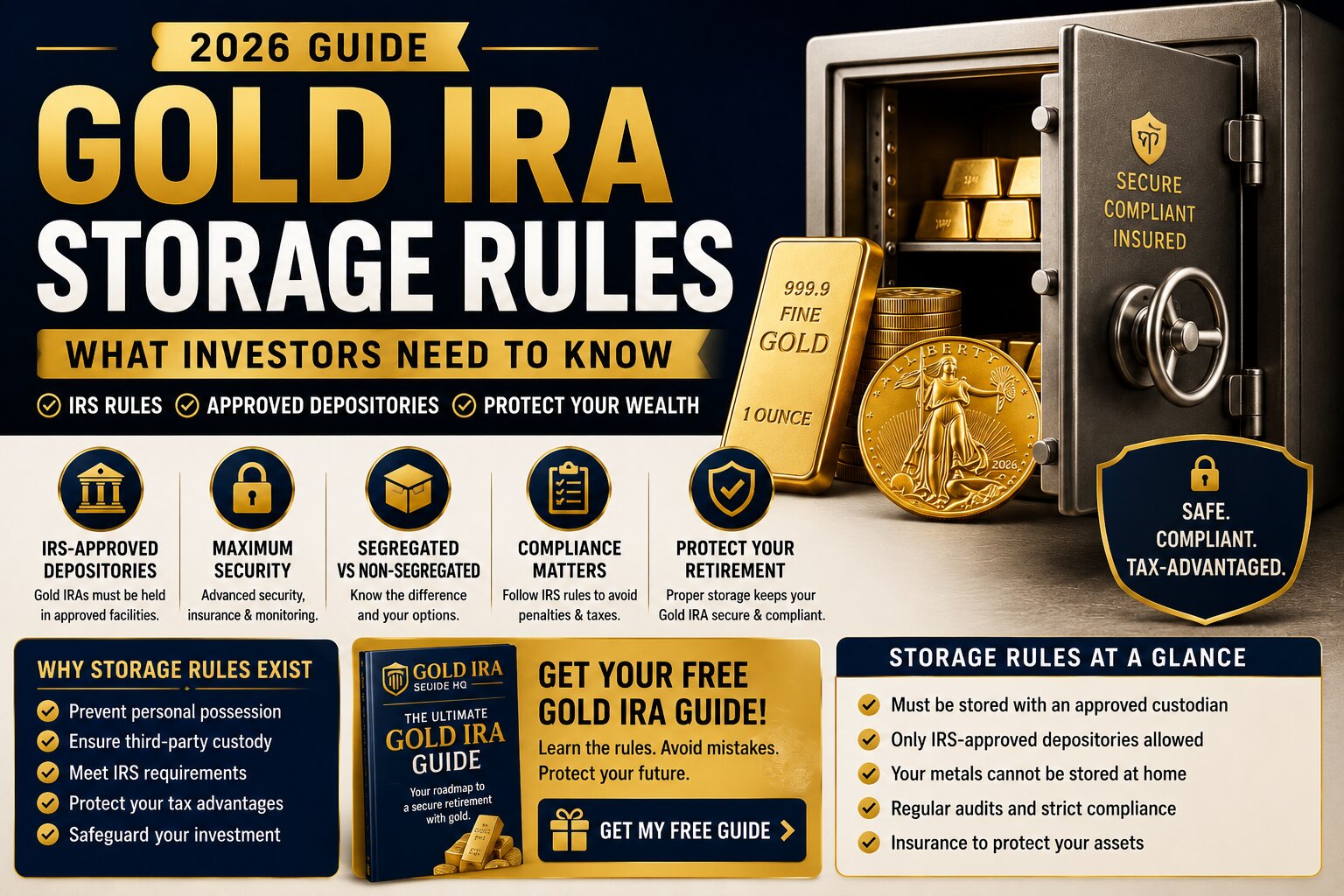
Understanding Gold IRA Storage Rules is essential before purchasing physical precious metals through a retirement account.
A Gold IRA does not work like buying bullion personally and placing it in a home safe. When qualifying physical precious metals are held within an IRA, federal rules impose custody requirements that investors need to understand.
The IRS generally treats metals and coins as collectibles, but federal law provides exceptions for certain qualifying coins and bullion. For qualifying bullion, the IRS states that a bank or approved non-bank trustee must keep physical possession of it.
This Gold IRA Storage Rules 2026 guide explains how that requirement works, the role of custodians and depositories, segregated versus non-segregated storage, home-storage concerns, insurance, fees and the questions investors should ask before opening an account.
If you’re completely new to precious-metals retirement accounts, start with our What Is a Gold IRA? guide first.
Gold IRA Storage Rules: Quick Summary
- Physical precious metals held through an IRA are subject to specific custody rules.
- For qualifying bullion under IRC Section 408(m), the IRS requires physical possession by a bank or approved non-bank trustee.
- Personally keeping IRA-owned bullion at home is not the ordinary custody structure contemplated by the IRS rule.
- The IRS says the possession requirement also applies to indirect arrangements such as an IRA-owned LLC buying bullion.
- Not every precious-metals product qualifies for IRA ownership.
- A precious-metals dealer and the IRA custodian may be separate companies.
- Storage pricing varies by custodian, depository and account structure.
- Segregated and non-segregated storage can have different costs and handling arrangements.
- Investors should understand insurance, audits, reporting and liquidation procedures before choosing storage.
What Are Gold IRA Storage Rules?
Gold IRA Storage Rules are the custody requirements that apply when certain physical precious metals are held inside an IRA.
They exist because an IRA is a retirement-account arrangement, not simply a label that can be attached to personally owned bullion.
When an investor purchases qualifying physical gold through an IRA, the asset is owned through the retirement account and must be handled in accordance with applicable IRA rules.
That generally involves:
- An IRA owner
- An appropriate trustee or custodian
- Qualifying precious metals
- A suitable physical custody arrangement
The IRS explains that certain highly refined bullion can qualify for an exception to the collectibles rules if the bullion is in the physical possession of a bank or an IRS-approved non-bank trustee.
Why Does a Gold IRA Need Special Storage?
A Gold IRA requires different administration from an IRA holding ordinary marketable securities because the account owns tangible physical assets.
Physical bullion must actually exist somewhere.
That creates questions involving possession, security, ownership records, insurance and account administration.
Federal IRA rules address this by requiring qualifying bullion under the relevant exception to be held in the physical possession of a bank or approved non-bank trustee.
This helps preserve separation between IRA property and personally controlled property.
What Does the IRS Say About Gold IRA Storage?
The IRS states that IRA investments in collectibles are generally restricted.
Metals and coins are generally included within the collectibles category.
However, there are exceptions for certain coins and certain qualifying gold, silver, platinum and palladium bullion.
For qualifying bullion, the IRS states that:
IRS Bullion Custody Requirement
Qualifying gold, silver, platinum or palladium bullion must satisfy the applicable fineness requirements and be kept in the physical possession of a bank or an approved non-bank trustee.
Investors can review the IRS guidance on precious metals and collectibles for the current federal framework.
Gold IRA Custodian vs Depository: What’s the Difference?
One common beginner mistake is assuming the custodian, precious-metals dealer and storage facility are always the same company.
They can perform different roles.
| Party | Primary Role |
|---|---|
| IRA Owner | Makes investment decisions within the permitted structure. |
| IRA Trustee / Custodian | Administers the IRA and handles applicable account reporting and custody responsibilities. |
| Precious Metals Dealer | Provides the gold, silver or other precious metals selected for purchase. |
| Depository / Storage Facility | Physically safeguards precious metals under the applicable custody arrangement. |
In practice, Gold IRA companies frequently help coordinate the process, but investors should know the identity of the actual custodian and where the metals will physically be stored.
What Is an Approved Non-Bank Trustee?
Banks are not the only institutions that can potentially serve in qualifying retirement-account trustee or custodian roles.
The IRS maintains a list of non-bank entities that have been approved to act as trustees or custodians when applicable requirements are satisfied. :contentReference[oaicite:1]{index=1}
The IRS explains that a prospective non-bank trustee must apply and demonstrate its ability to satisfy requirements contained in Treasury regulations before receiving written approval. :contentReference[oaicite:2]{index=2}
Investors researching Gold IRA Storage Rules should therefore distinguish between an IRS-approved non-bank trustee and a company that simply markets itself as a precious-metals storage provider.
Can You Store Gold IRA Metals at Home?
This is one of the most important questions in our Gold IRA Storage Rules 2026 guide.
The IRS specifically discusses this issue in its IRA FAQs.
According to the IRS, the exception for certain highly refined bullion requires the bullion to be in the physical possession of a bank or an IRS-approved non-bank trustee. :contentReference[oaicite:3]{index=3}
That makes ordinary personal home possession of IRA bullion very different from personally owning gold outside a retirement account.
Investors should therefore be extremely cautious about marketing suggesting that they can simply create an IRA, buy bullion with IRA funds and personally store the gold in a home safe.
What About a Home Storage Gold IRA LLC?
Some promoters discuss structures in which a self-directed IRA owns an LLC and the LLC purchases physical precious metals.
The argument is sometimes made that the IRA owner can then personally possess the bullion because the LLC—not the IRA owner directly—purchased it.
However, the IRS expressly states that the possession requirement for qualifying highly refined bullion also applies to indirect acquisitions, including when an IRA-owned LLC buys the bullion. :contentReference[oaicite:4]{index=4}
That makes this a particularly high-risk area for investors relying on aggressive home-storage marketing.
Before considering any unconventional precious-metals IRA structure, obtain qualified tax and legal advice specific to the arrangement.
Gold IRA Storage Rules for Coins vs Bullion
The IRA collectibles rules distinguish between various types of qualifying precious metals.
Certain coins are specifically included within statutory exceptions, while qualifying bullion must satisfy the relevant fineness and physical-possession requirements.
This means investors should not assume every coin, round or bar is treated identically.
Before purchasing any metal for an IRA, verify:
- The exact product
- Its purity or fineness
- Whether it falls within an applicable IRA exception
- How the custodian will hold it
- Where it will physically be stored
Which Precious Metals Can Be Stored in a Gold IRA?
Despite the name “Gold IRA,” qualifying self-directed precious-metals IRAs can potentially hold more than gold.
Federal law provides exceptions for certain qualifying:
- Gold
- Silver
- Platinum
- Palladium
However, each specific product should be checked against applicable IRA eligibility rules before purchase.
The IRS confirms that precious metals can be held only when specific requirements under IRC Section 408(m) are satisfied. :contentReference[oaicite:5]{index=5}
Learn Gold IRA Rules Before Moving Retirement Savings
Augusta’s free educational Gold IRA guide can help prospective investors learn how precious-metals IRAs work, including account structure, rollovers and important questions to consider before selecting a provider.
Affiliate link • Gold IRA Guide HQ may receive compensation from qualifying referrals.
What Is a Gold IRA Depository?
A precious-metals depository is a secure facility used to safeguard physical assets such as bullion.
Depending on the account arrangement, a depository may provide services involving:
- Secure vault storage
- Inventory controls
- Asset identification
- Insurance arrangements
- Audits or reconciliation procedures
- Shipment receipt and release
However, investors should avoid using the phrase “IRS-approved depository” too loosely.
The relevant federal rule focuses on physical possession by a bank or approved non-bank trustee. Investors should confirm the actual trustee/custodian structure rather than relying solely on a marketing label applied to a vault.
Segregated vs Non-Segregated Gold IRA Storage
Gold IRA providers may offer different storage arrangements.
Two terms investors frequently encounter are segregated storage and non-segregated storage.
| Storage Type | General Description | Potential Consideration |
|---|---|---|
| Segregated Storage | Your holdings are separately identified and maintained under the depository’s applicable procedures. | Can cost more depending on provider. |
| Non-Segregated / Commingled Storage | Holdings may be stored with comparable assets of other account holders while ownership records identify your account interest. | May have lower storage costs. |
Terminology and procedures can vary between custodians and depositories.
Before choosing either option, request a written explanation of exactly what the storage arrangement means for your specific account.
Is Segregated Storage Required by the IRS?
The IRS rule concerning qualifying bullion focuses on appropriate physical possession by a bank or approved non-bank trustee.
The IRS guidance we reviewed does not state that every precious-metals IRA must use a retail product specifically called “segregated storage.”
Therefore, investors should not confuse a provider’s storage product terminology with the underlying federal custody requirement.
The important question is whether the entire custody arrangement complies with applicable IRA rules.
How Much Does Gold IRA Storage Cost?
There is no universal storage fee that applies to every Gold IRA.
Costs can vary according to:
- The custodian
- The storage provider
- Storage type
- Account structure
- Account size
- Promotional arrangements
Some providers charge a flat annual amount, while others may use different pricing structures.
For a complete discussion of account and storage costs, read our Gold IRA Fees Explained guide.
Does Gold IRA Storage Include Insurance?
Many precious-metals custody arrangements include insurance-related protections, but investors should verify the details rather than assume every account is covered identically.
Ask:
- Who provides the insurance?
- What events are covered?
- What are the policy limits?
- Are limits applied per account or across the facility?
- Is insurance included in the quoted storage fee?
- Are there exclusions?
Insurance is a risk-management feature, not a substitute for understanding the legal custody structure.
Can You Visit a Gold IRA Depository?
Whether an account holder can physically visit a depository depends on the facility and custody arrangement.
Some facilities may permit scheduled visits or inspections under specific security procedures, while others may not provide customer access.
If direct access is important to you, ask the custodian or provider about the depository’s policy before opening the account.
Can You Move Gold Between Depositories?
Precious metals may potentially be moved between eligible custody arrangements, but this should generally be coordinated through the IRA custodian.
Investors should not personally take possession of IRA-owned bullion merely to move it from one vault to another.
Ask your custodian about:
- Transfer procedures
- Shipping
- Insurance during transit
- Transfer fees
- Processing times
- Documentation
What Happens to Gold IRA Storage When You Sell?
When IRA-owned precious metals are sold, the custodian and dealer generally coordinate the transaction through the account.
The metals are released according to the applicable custody process, and sale proceeds generally remain within the IRA unless a distribution is requested.
Before purchasing metals, investors should understand how liquidation works.
Ask the dealer what it would pay today to repurchase the products being offered to you.
That can help you evaluate the dealer’s current buy/sell spread.
Can You Take Physical Gold Out of a Gold IRA?
An IRA owner can potentially request a distribution of property from an IRA, subject to the applicable retirement-account rules and custodian procedures.
However, once assets are distributed from the IRA, the transaction may have tax consequences depending on the IRA type, the investor’s age and other circumstances.
Receiving physical metal rather than cash does not automatically make an IRA distribution tax-free.
See our Gold IRA Tax Rules guide for more detail.
Gold IRA Storage Rules and RMDs
Physical storage does not eliminate required minimum distribution obligations when those rules apply to the underlying IRA.
Traditional IRA owners who are subject to RMD rules still need to satisfy those requirements even when some retirement assets consist of physical precious metals.
That can create liquidity and valuation considerations.
Investors approaching RMD age should discuss distribution planning with their custodian and qualified tax adviser.
Gold IRA Storage Rules vs Personal Gold Storage
| Feature | Gold IRA Metals | Personally Owned Gold |
|---|---|---|
| Ownership Structure | Held through retirement account | Owned personally |
| IRA Custody Rules | Applicable | Not applicable |
| Home Storage | Personal possession creates serious compliance concerns | Owner generally chooses storage method |
| Product Eligibility | Must satisfy applicable IRA requirements | Broader personal choice |
| Retirement Tax Structure | IRA rules apply | No IRA structure |
Common Gold IRA Storage Mistakes
Gold IRA Storage Mistakes to Avoid
- Assuming any vault can automatically serve as IRA storage.
- Confusing a precious-metals dealer with the IRA custodian.
- Personally taking possession of IRA bullion without understanding the consequences.
- Assuming an IRA-owned LLC automatically permits home storage.
- Failing to verify whether a non-bank trustee is actually IRS approved.
- Buying metals before verifying IRA eligibility.
- Ignoring storage fees.
- Not asking whether insurance is included.
- Failing to understand segregated versus non-segregated storage.
- Ignoring liquidation and shipping procedures.
- Choosing a provider solely because it advertises “free storage.”
Are Free Gold IRA Storage Promotions Worth It?
Some precious-metals companies offer promotions that reimburse or cover storage fees for qualifying investors.
These offers can have value, but they should not determine your decision by themselves.
Ask:
- What investment amount qualifies?
- How many years are covered?
- Which storage fees are included?
- What will the normal fee be after the promotion?
- Does the promotion affect precious-metals pricing?
How to Choose Gold IRA Storage
Before opening an account, compare the entire storage and custody arrangement.
Gold IRA Storage Checklist
- Who is the IRA trustee or custodian?
- If non-bank, is the trustee/custodian IRS approved?
- Where will the physical metals be held?
- What type of storage is offered?
- How are my holdings identified?
- What is the annual storage cost?
- Is insurance included?
- How are inventories reconciled or audited?
- How are metals shipped into the facility?
- How are metals released when sold?
- Can I request an in-kind distribution?
- What transfer or shipping fees apply?
Gold IRA Storage Rules for Beginners
Beginners do not need to memorize the entire Internal Revenue Code.
But they should understand the basic custody concept:
A physical Gold IRA is not intended to operate like personally purchasing bullion and keeping it beside your other possessions.
The retirement-account structure matters, and qualifying bullion is subject to specific physical-possession requirements.
Our Best Gold IRA for Beginners guide explains additional questions first-time investors should ask.
Gold IRA Storage Rules When Rolling Over a 401(k)
The fact that money originally came from a 401(k) does not change the physical custody requirements that apply once qualifying precious metals are purchased inside the IRA.
The rollover and storage are two separate parts of the process.
First, eligible retirement assets need to be moved properly into the receiving IRA.
Then the IRA purchases qualifying precious metals and handles them through the appropriate custody arrangement.
Read our Gold IRA Rollover Guide for the funding side of the process.
Can the IRS Approve a Gold IRA Depository?
Investors frequently see the phrase “IRS-approved depository” in precious-metals marketing.
It is more precise to understand the underlying rule.
The IRS maintains a list of approved non-bank trustees and custodians, and qualifying bullion must be held in physical possession by a bank or approved non-bank trustee. :contentReference[oaicite:6]{index=6}
That does not mean the IRS is recommending a particular vault, dealer or investment.
Always verify the actual trustee/custodian arrangement behind the marketing language.
Compare Gold IRA Companies Before Choosing Storage
A Gold IRA company can help coordinate the custodian, precious-metals purchase and storage process. Augusta’s free educational guide is one resource you can use to understand the process before deciding whether to move retirement savings.
Affiliate disclosure: Gold IRA Guide HQ may receive compensation from qualifying referrals.
Gold IRA Storage Rules 2026: Final Thoughts
The most important lesson from our Gold IRA Storage Rules 2026 guide is that IRA-owned bullion is not treated exactly like personally owned gold.
The IRS generally restricts IRA investments in collectibles but provides exceptions for certain qualifying precious metals.
For qualifying bullion under the exception, federal guidance requires physical possession by a bank or approved non-bank trustee. :contentReference[oaicite:7]{index=7}
That requirement also applies to indirect arrangements such as an IRA-owned LLC buying bullion, which is particularly important for investors researching home-storage Gold IRA strategies. :contentReference[oaicite:8]{index=8}
Investors should therefore verify the actual custodian, trustee and storage structure before transferring retirement assets.
Storage fees, insurance, security procedures and segregated versus non-segregated options also deserve comparison, but none of those features should distract from the underlying compliance requirements.
Before opening an account, ask where the metals will be held, who controls them, what the arrangement costs and how the assets can later be sold or distributed.
Continue your research with our Gold IRA Tax Rules, Gold IRA Fees Explained, How to Open a Gold IRA, Gold IRA Rollover Guide and Best Gold IRA Companies.