Gold IRA Tax Rules 2026: Taxes, Rollovers, Contributions & Withdrawals
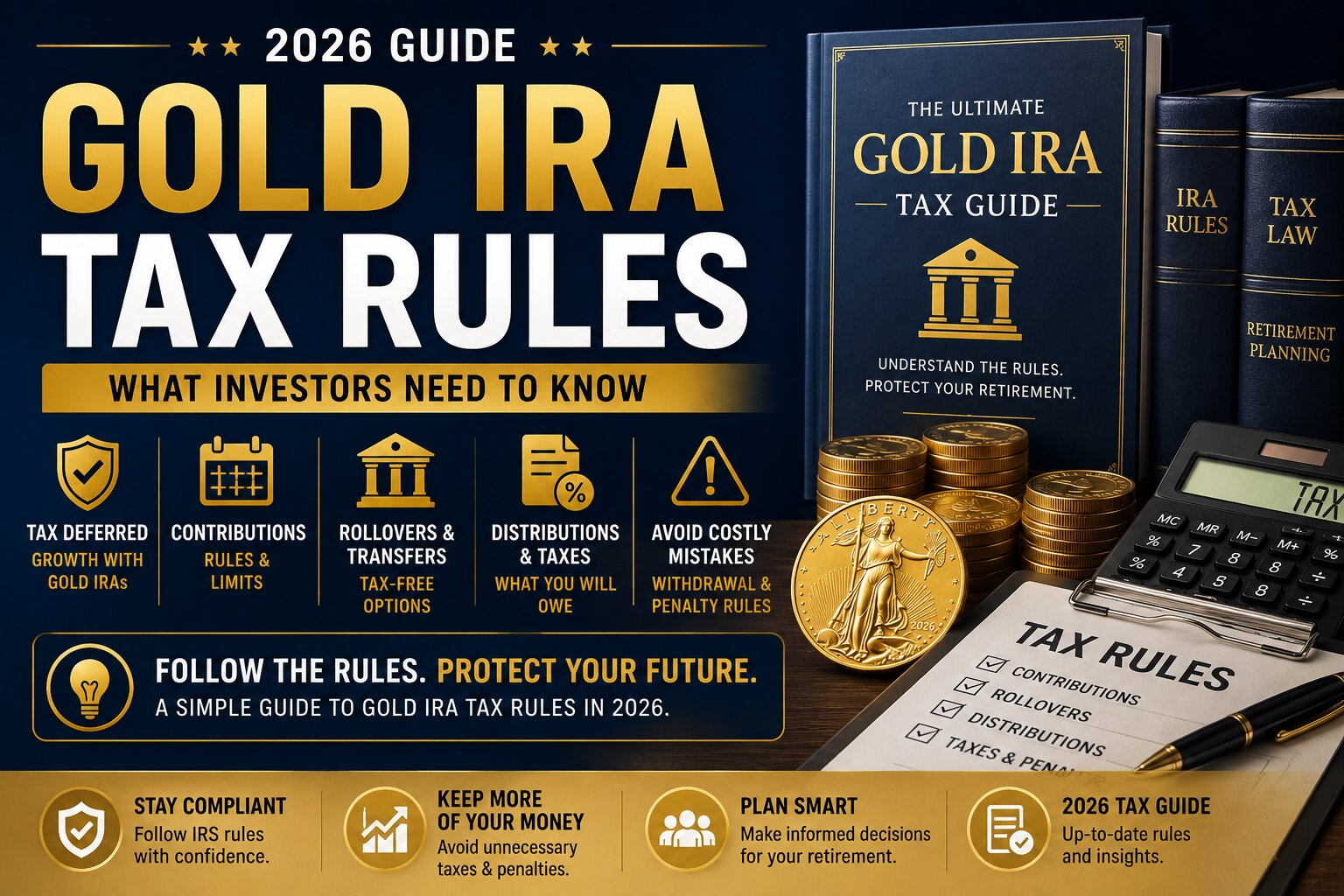
Understanding Gold IRA Tax Rules is essential before moving retirement money into physical precious metals. A Gold IRA can offer the tax characteristics associated with an IRA, but it also comes with contribution, rollover, distribution, custody and precious-metals rules investors need to understand.
One of the most important concepts is that a Gold IRA does not create a completely different tax system simply because the account owns gold.
Instead, the tax treatment generally depends on the type of IRA involved—such as a traditional or Roth IRA—while additional rules determine which precious metals may be held and how IRA-owned bullion must be handled.
This Gold IRA Tax Rules 2026 guide explains the major concepts in plain English, including contribution limits, rollovers, withdrawals, required minimum distributions, early-distribution rules and precious-metals eligibility.
If you are new to these accounts, first read What Is a Gold IRA? for an introduction to how the account works.
Gold IRA Tax Rules 2026: Quick Summary
- A Gold IRA generally follows the tax rules applicable to the underlying IRA type.
- The 2026 combined annual IRA contribution limit is $7,500.
- Eligible individuals age 50 or older can contribute an additional $1,100 in 2026.
- Rollovers are different from regular annual IRA contributions.
- Eligible direct retirement-plan rollovers generally do not use your annual IRA contribution limit.
- Traditional IRA distributions are generally taxable except to the extent they represent previously taxed basis.
- Taxable early IRA distributions may generally face an additional 10% tax unless an exception applies.
- Traditional IRA owners generally begin required minimum distributions at age 73 under current rules.
- Original Roth IRA owners generally do not have lifetime RMDs.
- Not every gold coin or bar qualifies for IRA ownership.
- Certain qualifying bullion must meet applicable custody requirements.
How Do Gold IRA Tax Rules Work?
The easiest way to understand Gold IRA Tax Rules is to separate the retirement account from the asset held inside it.
A Gold IRA is generally a self-directed IRA structured to permit certain alternative assets, including qualifying physical precious metals.
The IRA provides the retirement-account tax framework. The gold or other qualifying precious metals are investments held through that account.
Therefore, whether contributions may be deductible, how distributions are taxed, and whether required minimum distributions apply depends significantly on whether the account is structured as a traditional IRA or Roth IRA.
Traditional Gold IRA Tax Rules
A traditional Gold IRA generally follows traditional IRA tax principles.
Depending on the investor’s circumstances, contributions to a traditional IRA may be deductible. Deductibility can depend on factors including income and participation in an employer-sponsored retirement plan.
Investment gains occurring inside the account generally are not reported as annual taxable investment gains while they remain inside the IRA.
When money or assets are eventually distributed from a traditional IRA, taxable amounts are generally included in ordinary income.
If an investor has made nondeductible traditional IRA contributions, part of a distribution may represent basis and therefore may not be taxable. Tax calculations can become more complex in these situations.
Roth Gold IRA Tax Rules
A Roth Gold IRA uses the Roth IRA framework while holding eligible precious metals through an appropriate self-directed account.
Roth IRA contributions are generally made with after-tax dollars rather than being deducted from current taxable income.
Qualified Roth IRA distributions can be tax-free when applicable requirements are satisfied.
Another important difference is that original Roth IRA owners are generally not required to take lifetime required minimum distributions under current federal rules.
However, Roth IRAs have eligibility and contribution rules, and Roth conversions can create current-year tax consequences.
Traditional Gold IRA vs Roth Gold IRA Taxes
| Tax Feature | Traditional Gold IRA | Roth Gold IRA |
|---|---|---|
| Contributions | May be deductible depending on circumstances | Generally made after tax |
| Growth Inside IRA | Generally tax-deferred | Potentially tax-free when Roth requirements are satisfied |
| Qualified Retirement Withdrawals | Taxable amounts generally included as ordinary income | Qualified distributions generally tax-free |
| Lifetime RMDs for Original Owner | Generally yes | Generally no |
| Income Rules for Contributions | Deduction eligibility can depend on income and plan participation | Direct contribution eligibility is income-sensitive |
Gold IRA Contribution Limits for 2026
One of the most important Gold IRA Tax Rules 2026 involves the annual IRA contribution limit.
For 2026, the standard annual contribution limit for IRAs is $7,500.
For eligible individuals age 50 or older, the 2026 catch-up amount is $1,100, bringing the potential combined limit to $8,600.
| 2026 IRA Contribution | Limit |
|---|---|
| Under Age 50 | $7,500 |
| Age 50+ | $8,600 total, including $1,100 catch-up |
These are IRA contribution limits—not separate Gold IRA limits.
For example, you generally cannot contribute the full annual limit to a traditional IRA and then make another full regular contribution to a separate Gold IRA simply because it holds precious metals. The annual limit generally applies across your traditional and Roth IRAs.
Does a Gold IRA Rollover Count as a Contribution?
This is one of the most common areas of confusion surrounding Gold IRA Tax Rules.
A qualifying rollover is not the same thing as making a regular annual IRA contribution.
That distinction is important because investors may sometimes move substantially more than the annual IRA contribution limit when transferring eligible retirement assets through a properly executed rollover.
For example, an eligible retirement-plan distribution may potentially be rolled into an IRA even when the amount is greater than the annual IRA contribution limit.
The rollover itself must satisfy applicable requirements.
For a detailed walkthrough, read our Gold IRA Rollover Guide.
Direct Gold IRA Rollovers and Transfers
When possible and appropriate, investors often prefer arrangements where retirement funds move directly between qualified institutions rather than being paid personally to the investor.
Direct movement of retirement funds can reduce some of the complications associated with receiving a distribution personally and then attempting to redeposit it.
The exact process depends on whether money is moving from an employer plan, from another IRA, or through another eligible retirement arrangement.
Investors should coordinate with the institutions and custodian involved before initiating the movement of funds.
The 60-Day Gold IRA Rollover Rule
An important part of Gold IRA Tax Rules applies when an investor actually receives an eligible retirement distribution rather than arranging a direct transfer.
Under the general IRS rollover rule, an eligible distribution that is paid to you normally must be rolled over to another eligible retirement plan or IRA within 60 days.
Missing the deadline can cause the distribution to become taxable unless an applicable waiver or other relief is available.
Depending on the investor’s age and circumstances, an additional tax on early distributions may also apply.
The One-Rollover-Per-Year Rule
Another rule investors should understand applies to certain IRA-to-IRA rollovers.
The IRS generally limits an individual to one IRA-to-IRA rollover within a 12-month period when the distribution is received by the IRA owner and subsequently rolled over.
Importantly, the IRS explains that this one-per-year restriction does not apply in the same way to trustee-to-trustee transfers, traditional-to-Roth conversions, plan-to-IRA rollovers, IRA-to-plan rollovers or plan-to-plan rollovers.
This is another reason the method used to move retirement funds matters.
Gold IRA Tax Rules for 401(k) Rollovers
Many investors become interested in Gold IRAs because they already have money in an employer-sponsored retirement account such as a 401(k).
Many eligible retirement-plan distributions can potentially be rolled into an IRA. However, not every distribution qualifies.
For example, the IRS identifies certain distributions that generally cannot be rolled over, including required minimum distributions and certain hardship distributions.
Whether money can be moved from a current employer’s plan may also depend on the specific plan rules.
For a broader account comparison, see Gold IRA vs 401(k).
Are Gold IRA Rollovers Tax-Free?
A properly executed rollover between compatible retirement accounts can generally allow eligible retirement funds to move without being treated as a currently taxable distribution.
But that does not mean every retirement-account movement is tax-free.
Moving pre-tax traditional retirement assets into a Roth IRA, for example, is generally a conversion, and previously untaxed amounts converted to the Roth IRA are generally included in taxable income.
That is fundamentally different from moving eligible pre-tax retirement assets to another compatible traditional IRA arrangement.
Gold IRA Tax Rules for Roth Conversions
Some investors consider converting traditional retirement assets into a Roth IRA that can hold eligible precious metals.
A Roth conversion can have significant tax consequences.
The IRS explains that when a traditional IRA is converted to a Roth IRA, previously untaxed amounts included in the conversion generally become taxable.
The potential long-term Roth benefits therefore need to be weighed against the current tax cost of conversion.
Are Gold IRA Gains Taxed Every Year?
One potential benefit of holding qualifying precious metals through an IRA is that investors generally do not report annual gains and losses inside an open IRA in the same manner as they would for investments held in an ordinary taxable account.
For a traditional IRA, taxation generally becomes relevant when taxable distributions occur.
For a Roth IRA, qualified distributions may be tax-free when the applicable requirements are satisfied.
This tax treatment is tied to the retirement-account structure rather than to gold receiving a unique exemption from taxation.
Learn How a Gold IRA Works Before Moving Retirement Funds
Augusta’s free educational Gold IRA guide can help investors understand precious metals, retirement-account mechanics and important questions to ask before making a decision.
Affiliate link • Gold IRA Guide HQ may receive compensation from qualifying referrals.
Gold IRA Withdrawal Tax Rules
Understanding distributions is another essential part of Gold IRA Tax Rules.
With a traditional IRA, distributions of previously untaxed amounts are generally included in taxable income.
The tax result can be different when the account includes nondeductible contributions because the investor may have basis in the IRA.
Roth IRA distribution rules are different, and qualified Roth distributions can be tax-free.
Because individual tax circumstances vary, investors approaching retirement should understand the tax treatment of their particular IRA before requesting a distribution.
Gold IRA Early Withdrawal Rules
Taking retirement money out too early can create additional tax consequences.
Taxable IRA distributions received before age 59½ may generally be subject to an additional 10% tax unless an IRS exception applies.
This additional tax can apply on top of ordinary income tax owed on the taxable portion of the distribution.
There are statutory exceptions to the additional tax, so the result depends on the circumstances surrounding the distribution.
Gold IRA Required Minimum Distribution Rules
Required minimum distributions are particularly important for investors holding traditional Gold IRAs.
Under current rules, traditional IRA owners generally must begin taking RMDs when they reach age 73.
The first RMD generally must be taken for the year the owner reaches age 73, although the first payment can generally be delayed until April 1 of the following year.
Subsequent annual RMDs are generally due by December 31.
Delaying the first distribution can result in two taxable RMDs occurring during the same calendar year, so tax planning can matter.
Do Roth Gold IRAs Have Required Minimum Distributions?
Original Roth IRA owners generally do not have required minimum distributions during their lifetime under current federal rules.
That can make Roth IRAs attractive to some retirement savers who do not need to withdraw assets merely because they have reached a particular age.
Beneficiaries, however, can be subject to distribution requirements after the original owner’s death.
How Do RMDs Work When an IRA Owns Physical Gold?
Holding physical precious metals does not eliminate required minimum distributions when RMD rules apply to the underlying IRA.
This can create additional planning considerations because physical gold is not cash.
Investors approaching RMD age should discuss with their custodian how distributions can be handled and whether sufficient liquidity is available elsewhere in their IRA arrangements.
RMD calculations and distributions can become more complicated when retirement assets are illiquid or difficult to value.
Which Gold Can Be Held in an IRA?
The Gold IRA Tax Rules do not allow investors to place just any gold product inside an IRA.
Federal law generally treats metals and coins as collectibles for IRA purposes, but provides exceptions for certain coins and certain highly refined bullion meeting statutory requirements.
This means a collectible gold coin may be inappropriate for an IRA even though it contains valuable gold.
Investors should verify eligibility with the IRA custodian before purchasing precious metals for an IRA.
Can You Store Gold IRA Metals at Home?
Home storage is one of the most misunderstood areas of Gold IRA Tax Rules 2026.
The IRS states that certain highly refined bullion receives an exception from the IRA collectibles rules when the bullion is in the physical possession of a bank or an IRS-approved nonbank trustee.
The IRS specifically warns that this rule also applies to indirect arrangements, such as an IRA-owned LLC acquiring the bullion.
Investors should therefore be cautious about promotions claiming that IRA-owned bullion can simply be stored personally at home without potential tax consequences.
What Happens If an IRA Buys a Non-Qualifying Collectible?
This is another reason investors need to understand precious-metals eligibility.
According to IRS guidance, when an IRA invests in a collectible, the amount invested can be treated as distributed in the year of the investment.
That can potentially create current taxable income and, depending on age and circumstances, an additional tax on an early distribution.
The exceptions for qualifying precious metals therefore matter substantially.
Gold IRA Fees and Taxes Are Different
Investors sometimes confuse account fees with taxes.
They are not the same.
Gold IRA costs can include custodian fees, administration charges, storage costs, dealer premiums and buy/sell spreads.
Those expenses can affect your investment economics even when no current income tax is due on investment activity inside the IRA.
Read our Gold IRA Fees Explained guide to understand the cost side separately.
Common Gold IRA Tax Mistakes to Avoid
Gold IRA Tax Rules Checklist
- Do not assume every gold coin or bar is IRA-eligible.
- Do not confuse an IRA rollover with a regular annual contribution.
- Do not ignore the 60-day deadline when receiving an indirect rollover distribution.
- Understand the one-rollover-per-year rule for applicable IRA-to-IRA rollovers.
- Do not assume a Roth conversion is tax-free.
- Understand potential additional taxes before taking an early distribution.
- Plan for traditional IRA required minimum distributions.
- Do not assume home storage of IRA bullion automatically satisfies IRS requirements.
- Keep documentation relating to rollovers, contributions and distributions.
- Verify current IRS limits instead of relying on outdated contribution figures.
- Ask a qualified tax professional about circumstances specific to you.
Gold IRA Tax Rules vs Regular Physical Gold
Holding physical gold personally and holding qualifying precious metals through an IRA are fundamentally different structures.
Personally owned gold is not automatically covered by IRA tax treatment simply because you intend to use it for retirement.
An IRA, by contrast, must comply with retirement-account rules, including requirements affecting contributions, distributions, investments and custody.
That structure can provide retirement-account tax characteristics but also creates restrictions that do not apply in exactly the same way to personally owned bullion.
Gold IRA Tax Rules for Selling Metals Inside the IRA
An IRA may sell precious metals held within the retirement account without the sale automatically being treated the same way as a personal taxable-account sale.
The proceeds remain retirement-account assets when they remain properly inside the IRA.
The eventual tax treatment generally depends on the IRA structure and distributions from the account.
Investors should nevertheless pay attention to dealer spreads and transaction pricing because those economic costs can affect account value even when a sale does not generate a currently reported personal capital gain.
Gold IRA Tax Rules for In-Kind Distributions
Investors may sometimes have questions about receiving physical precious metals rather than cash when taking an IRA distribution.
A distribution of property from an IRA can still be a retirement-account distribution for tax purposes.
Receiving the actual gold does not automatically eliminate the tax consequences that would otherwise apply to a taxable traditional IRA distribution.
Investors considering an in-kind precious-metals distribution should coordinate with their IRA custodian and tax professional regarding valuation, reporting and applicable tax treatment.
How to Open a Gold IRA Without Creating Avoidable Tax Problems
A careful setup process can help investors avoid unnecessary complications.
- Learn how self-directed IRAs and precious-metals rules work.
- Choose an appropriate IRA custodian.
- Determine whether you are making a contribution, transfer or rollover.
- Confirm whether the source retirement account is eligible for the intended transaction.
- Use qualifying precious metals.
- Follow applicable custody requirements.
- Maintain records of transactions and retirement-account movements.
- Consult a tax professional when the transaction has material tax consequences.
See our complete How to Open a Gold IRA guide for the account-opening process.
Questions to Ask Before a Gold IRA Rollover
Before Moving Retirement Money, Ask:
- Is my current retirement account eligible for the intended rollover?
- Will the funds move directly between institutions?
- Could any part of this transaction be taxable?
- Does the 60-day rule apply?
- Could the one-rollover-per-year limitation apply?
- Am I converting traditional assets to a Roth IRA?
- Which precious metals are eligible for the new IRA?
- Who will serve as custodian?
- Where will the metals be held?
- What documentation will I receive?
Where to Verify Current Gold IRA Tax Rules
Tax laws and annual contribution limits can change.
For that reason, investors should verify current information directly with authoritative sources before acting.
The IRS Retirement Plans FAQs Regarding IRAs provides information about IRA rollovers, investments, precious-metals collectibles rules and bullion custody.
For significant rollovers, Roth conversions, distributions or unusual precious-metals arrangements, consider consulting a qualified tax professional.
Research Gold IRAs Before Making a Rollover
Understanding taxes is only one part of evaluating a Gold IRA. Augusta’s free educational guide can help you learn more about precious metals and Gold IRA mechanics before deciding whether this type of account fits your retirement strategy.
Affiliate disclosure: Gold IRA Guide HQ may receive compensation from qualifying referrals.
Gold IRA Tax Rules 2026: Final Thoughts
Understanding Gold IRA Tax Rules 2026 is about much more than asking whether gold receives tax advantages.
The tax treatment comes primarily from the retirement-account structure, while additional rules govern contributions, rollovers, distributions, eligible precious metals and custody.
For 2026, the standard IRA contribution limit is $7,500, with an additional $1,100 catch-up contribution available to eligible individuals age 50 or older.
Qualifying rollovers are different from annual contributions, but rollover rules must be followed carefully. An indirect rollover can generally involve a 60-day deadline, while certain IRA-to-IRA rollovers are also subject to the one-rollover-per-year limitation.
Traditional IRA investors should also plan for taxable distributions and required minimum distributions, while Roth IRA investors need to understand the rules governing contributions, conversions and qualified distributions.
Finally, precious-metals investors must remember that not every gold product is appropriate for an IRA and that qualifying bullion is subject to custody requirements.
Before making a significant retirement-account transaction, verify the current rules and consider professional tax advice tailored to your circumstances.
Continue your research with our Gold IRA Rollover Guide, Gold IRA Fees Explained, How to Open a Gold IRA, Gold IRA vs 401(k) and Best Gold IRA for Beginners.