Gold IRA Pros and Cons 2026: Is a Gold IRA Worth It?
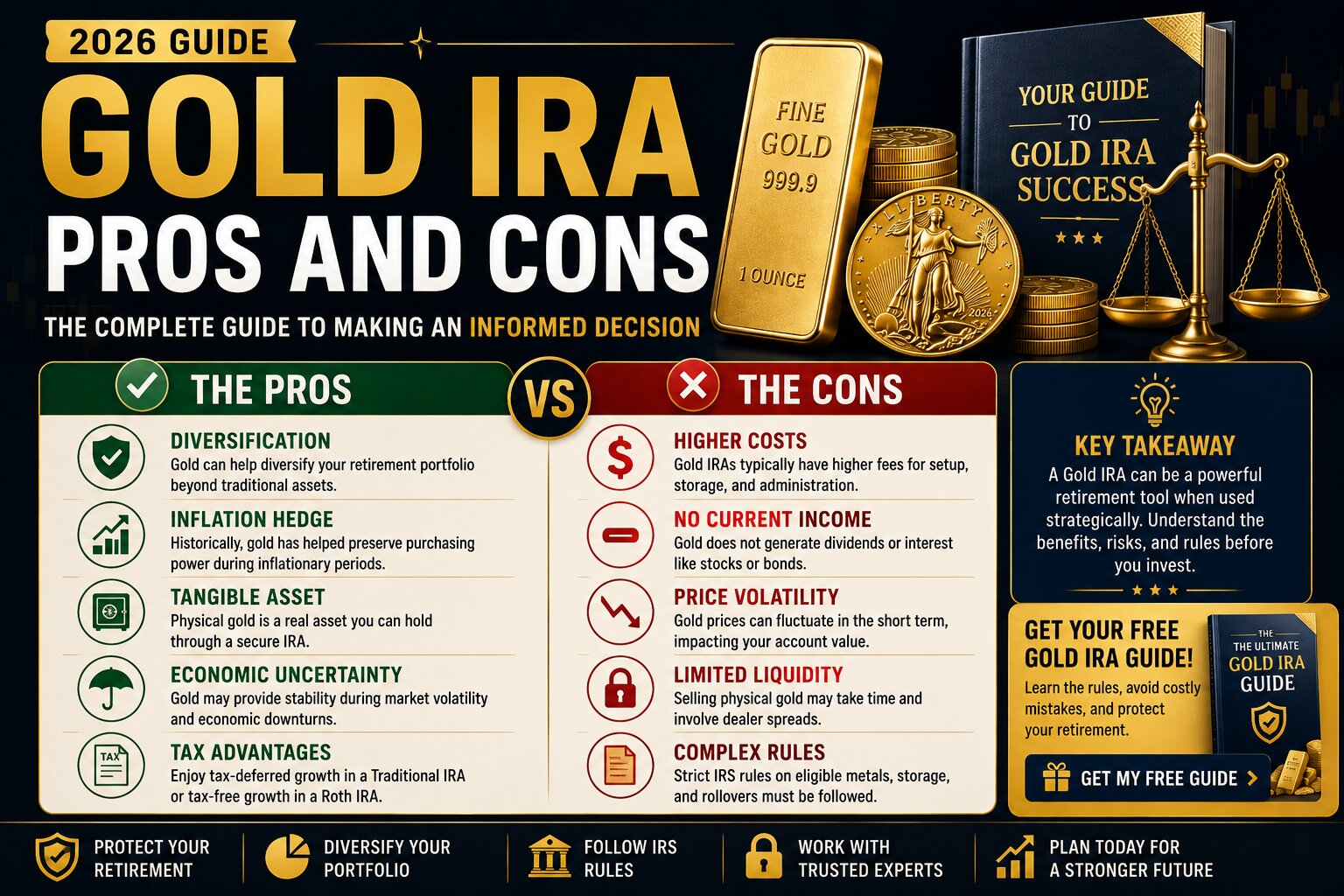
Understanding the Gold IRA Pros and Cons is one of the most important steps to take before moving retirement savings into physical precious metals.
Gold IRAs are frequently promoted as a way to diversify retirement savings, own tangible precious metals and reduce dependence on conventional financial assets. But these accounts also have disadvantages, including storage and administrative costs, special IRS rules, dealer spreads and the fact that physical gold does not generate dividends or interest.
That means a Gold IRA should not automatically be viewed as either a “good” or “bad” investment.
Whether it makes sense depends on your retirement objectives, existing asset allocation, risk tolerance, liquidity needs, time horizon and the price you pay for precious metals.
This Gold IRA Pros and Cons 2026 guide examines both sides so you can make a more informed decision.
If you are unfamiliar with how these accounts work, read What Is a Gold IRA? before continuing.
Gold IRA Pros and Cons: Quick Summary
| Potential Advantages | Potential Disadvantages |
|---|---|
| Can add physical precious metals to a retirement portfolio | Usually involves additional account and storage costs |
| May improve diversification | Gold produces no dividends or interest |
| Provides exposure to a tangible asset | Gold prices can rise or fall substantially |
| May behave differently from stocks and bonds | Physical metals can be less liquid than publicly traded securities |
| Uses an IRA retirement-account structure | Special eligibility and custody rules apply |
| Can potentially receive eligible retirement rollovers | Dealer spreads can affect returns |
| Can provide an alternative asset allocation | Scams and aggressive sales tactics exist in the industry |
What Is a Gold IRA?
Before examining the Gold IRA Pros and Cons, it helps to understand exactly what the account is.
A Gold IRA generally refers to a self-directed individual retirement account structured so that it can hold certain qualifying physical precious metals.
The account itself is an IRA. Gold is simply one type of investment held through it.
Depending on the structure and eligibility requirements, investors may potentially use a traditional or Roth IRA framework while gaining exposure to qualifying physical precious metals.
Gold IRAs are different from simply purchasing coins or bars personally because the retirement account must comply with applicable IRA rules.
Gold IRA Pros and Cons at a Glance
The central trade-off is relatively straightforward.
A Gold IRA can give retirement savers access to a tangible alternative asset inside an IRA structure, but obtaining that exposure generally involves more complexity and expense than owning conventional securities through a standard IRA.
Gold IRA Pros: Potential Advantages
Let’s begin the Gold IRA Pros and Cons comparison with the potential advantages.
✓ Pro #1: Portfolio Diversification
One of the main reasons investors consider gold is diversification.
Diversification means spreading investments across different assets rather than depending excessively on one company, sector or asset class.
Because physical gold has different economic characteristics from stocks and bonds, adding some precious-metals exposure may change the risk profile of a portfolio.
However, diversification does not guarantee profits or prevent losses.
✓ Pro #2: Exposure to a Tangible Asset
Physical gold is a tangible asset rather than a contractual claim on a company.
Some investors value having part of their retirement portfolio backed by physical precious metals held through an appropriate custody arrangement.
This characteristic distinguishes a physical Gold IRA from accounts invested entirely in stocks, bonds, mutual funds or other financial securities.
✓ Pro #3: Alternative Exposure During Economic Uncertainty
Investors frequently become interested in gold during periods involving inflation, financial-market stress, geopolitical uncertainty or concerns about currencies.
Gold has existed as a store of value for centuries, which helps explain its continuing role in modern portfolios.
However, gold does not rise during every crisis, and its short-term performance should never be treated as guaranteed.
✓ Pro #4: Retirement-Account Tax Structure
Another potential advantage in the Gold IRA Pros and Cons discussion is the IRA structure itself.
Traditional IRAs generally allow investment growth to occur without annual taxation inside the account, with taxable amounts generally recognized when distributed.
Qualified Roth IRA distributions can potentially be tax-free when the applicable requirements are satisfied.
These benefits come from the IRA structure—not because physical gold receives a special blanket tax exemption.
✓ Pro #5: Eligible Retirement Assets Can Potentially Be Rolled Over
Some investors fund a Gold IRA by rolling eligible assets from another retirement arrangement into an IRA.
A qualifying rollover is different from making a normal annual IRA contribution.
This distinction can allow investors to reposition existing retirement assets without being restricted to the normal annual contribution limit, provided the transaction qualifies and is executed correctly.
See our Gold IRA Rollover Guide for a detailed explanation.
✓ Pro #6: Gold Has No Corporate Issuer
A share of stock depends partly on the performance and financial health of the company that issued it.
A corporate bond involves the creditworthiness of its issuer.
Physical gold is different because the metal itself is the asset.
This does not make gold risk-free, but it gives the asset a different risk profile from securities dependent on a specific corporate issuer.
✓ Pro #7: Long-Term Portfolio Flexibility
Some retirement savers want exposure to more than conventional stocks and bonds.
A self-directed IRA can potentially provide broader investment flexibility, including qualifying precious metals.
For investors who deliberately want physical-metal exposure, this can be an important advantage.
Gold IRA Cons: Potential Disadvantages
A balanced Gold IRA Pros and Cons analysis must give equal attention to the disadvantages.
Several of these drawbacks can materially affect investment results.
✕ Con #1: Gold IRAs Can Have Higher Fees
Physical precious-metals IRAs commonly involve costs that may not exist in the same form in a basic brokerage IRA.
Depending on the provider and custodian, costs can include:
- Account setup fees
- Annual administration or custodian fees
- Physical storage fees
- Transaction-related charges
- Shipping or handling costs
- Precious-metal dealer spreads
Read Gold IRA Fees Explained before opening an account.
✕ Con #2: Physical Gold Does Not Generate Income
A stock may pay dividends.
A bond may generate interest.
Physical gold itself does neither.
Your return generally depends primarily on what happens to the value of the metal relative to your purchase price and the costs associated with buying, holding and selling it.
This opportunity cost is especially important for long-term retirement investors who value income-producing assets.
✕ Con #3: Gold Prices Can Fall
Gold is sometimes marketed as though it only increases in value.
That is incorrect.
Gold prices fluctuate and can experience prolonged periods of weak or negative performance.
No investor should purchase gold on the assumption that appreciation is guaranteed.
✕ Con #4: Dealer Spreads Can Reduce Returns
This is one of the most important disadvantages for prospective Gold IRA investors to understand.
A dealer may sell a precious-metal product for more than the amount it would pay to repurchase the same product.
That difference is commonly called the spread.
A large spread means the metal may need to appreciate significantly before the investor breaks even on the transaction.
Always ask for both the current selling price and the current repurchase price before purchasing precious metals.
✕ Con #5: IRS Rules Add Complexity
A Gold IRA involves more rules than simply purchasing gold personally.
Not every coin or bar can automatically be purchased through an IRA.
Federal law generally treats metals and coins as collectibles, while providing exceptions for certain qualifying coins and bullion.
Read our Gold IRA Storage Rules and Gold IRA Tax Rules guides before proceeding.
✕ Con #6: You Cannot Simply Keep IRA Bullion at Home
Investors sometimes assume that because they bought the gold with their retirement money, they can put the IRA-owned bullion in a home safe.
That assumption can create serious compliance problems.
For qualifying bullion under the precious-metals exception, IRS guidance requires physical possession by a bank or an approved non-bank trustee.
The IRS also states that this requirement applies to indirect arrangements such as an IRA-owned LLC purchasing the bullion.
✕ Con #7: Physical Gold Can Be Less Convenient to Liquidate
Selling a publicly traded stock or ETF can often be completed electronically during market hours.
Selling physical precious metals involves a different process.
The dealer, custodian and storage arrangement may all play a role in liquidation.
Investors should understand the process, expected timing and applicable costs before buying.
✕ Con #8: Industry Sales Practices Require Careful Due Diligence
Precious-metals investors can encounter aggressive marketing.
Be cautious about:
- Guaranteed-return claims
- Claims that gold cannot lose value
- High-pressure rollover tactics
- Fear-based sales presentations
- Unclear pricing
- Large markups
- Unusual home-storage claims
- Pressure to purchase collectible or high-premium products
A reputable provider should give you enough information and time to understand what you are purchasing.
Gold IRA Pros and Cons Comparison Table
| Factor | Potential Benefit | Potential Drawback |
|---|---|---|
| Diversification | Adds an alternative asset | Over-allocation can create concentration risk |
| Physical Asset | Tangible precious-metal ownership through IRA | Requires appropriate custody |
| Income | Potential price appreciation | No dividends or interest from physical gold |
| Costs | Can be manageable depending on account size/provider | Custodian, storage and dealer costs can add up |
| Liquidity | Physical gold has an established market | Liquidation can be less convenient than selling listed securities |
| Taxes | IRA structure can provide retirement tax treatment | IRA tax and distribution rules still apply |
| Control | Self-directed structure offers alternative investment choices | Personal possession of IRA bullion is restricted |
Learn More Before Deciding Whether a Gold IRA Is Right for You
Augusta’s free educational Gold IRA guide can help you understand precious metals, rollovers and important considerations before deciding whether a Gold IRA belongs in your retirement strategy.
Affiliate link • Gold IRA Guide HQ may receive compensation from qualifying referrals.
Are Gold IRAs Tax-Free?
One common misunderstanding in the Gold IRA Pros and Cons discussion is that a Gold IRA somehow makes gold automatically tax-free.
It does not.
The retirement-account structure determines much of the tax treatment.
Traditional IRA distributions of previously untaxed amounts are generally taxable, while qualified Roth IRA distributions can generally be tax-free.
For 2026, the combined contribution limit across traditional and Roth IRAs is $7,500, or $8,600 for eligible individuals age 50 or older.
Rollovers are different from regular annual contributions and generally do not count against this contribution limit when properly completed.
For a more detailed explanation, see Gold IRA Tax Rules 2026.
Does a Gold IRA Protect Against Inflation?
Inflation protection is often listed among the potential benefits of gold.
The idea is that a scarce tangible asset may preserve purchasing power differently from cash when the general price level rises.
But investors should be careful with absolute claims.
Gold does not track inflation perfectly over every month or year, and its price can be influenced by many factors including interest rates, currency movements, investor sentiment and global demand.
Therefore, “potential inflation diversification” is more accurate than saying gold is guaranteed to protect an investor from inflation.
Can You Lose Money With a Gold IRA?
Yes.
This is a crucial point when considering the Gold IRA Pros and Cons.
A Gold IRA can lose value if:
- Gold prices decline
- You pay a high dealer markup
- The buy/sell spread is large
- Fees consume part of the account’s return
- You sell during an unfavorable market
- You overpay for particular coins or bars
A retirement-account structure does not protect an investment from market losses.
Gold IRA vs Physical Gold Outside an IRA
Investors deciding whether a Gold IRA is worth it should distinguish between IRA-owned precious metals and personally owned bullion.
| Feature | Gold IRA | Personal Physical Gold |
|---|---|---|
| Retirement Account | Yes | No |
| IRA Tax Structure | Yes | No |
| Personal Home Possession | Subject to IRA custody restrictions | Generally chosen by owner |
| Product Choice | Must satisfy applicable IRA rules | Much broader |
| Custodian | Required within IRA structure | Not generally required |
| Storage Fees | Common | Depends on owner’s storage choice |
Gold IRA vs 401(k): Pros and Cons
A 401(k) and a Gold IRA serve different purposes.
A typical 401(k) may provide access to diversified mutual funds or other investment options, and some employers provide matching contributions.
A physical Gold IRA can provide direct exposure to qualifying precious metals, but generally introduces additional custody and storage requirements.
It does not necessarily need to be an all-or-nothing decision.
Depending on eligibility and individual circumstances, an investor may potentially maintain conventional retirement assets while allocating another portion to alternative assets.
Read our full Gold IRA vs 401(k) comparison for more detail.
Gold IRA vs Stocks
Stocks represent ownership interests in businesses.
Successful companies can potentially grow earnings, reinvest profits and pay dividends.
Physical gold does not operate a business or generate corporate earnings.
Its investment return is primarily determined by changes in the market value of the metal after accounting for transaction and ownership costs.
For this reason, gold and stocks can play very different roles in a retirement portfolio.
Gold IRA vs Gold ETF
Investors who simply want exposure to gold prices may also consider exchange-traded products rather than physical bullion held through a self-directed IRA.
A gold ETF can generally be easier to buy and sell through a brokerage account and may avoid some of the logistics associated with physical bullion.
A physical Gold IRA, on the other hand, is designed for investors who specifically want qualifying physical precious metals held through an IRA custody arrangement.
The better choice depends partly on whether physical ownership through the retirement account is important to the investor.
Gold IRA Fees Can Change the Pros and Cons
Account size can materially affect the economics of a Gold IRA.
Suppose two investors pay the same $250 in annual account-related fees.
For a $25,000 account, $250 represents 1% of account value.
For a $100,000 account, the same $250 represents 0.25%.
This simple example demonstrates why fixed fees can have a proportionally larger effect on smaller accounts.
It is therefore important to evaluate costs relative to the amount you intend to invest.
Gold IRA Pros and Cons for Retirees
Retirees may evaluate gold differently from younger investors.
Someone already taking retirement distributions may place greater emphasis on liquidity, income and required minimum distributions.
Traditional IRA owners generally must begin RMDs at age 73 under current rules. Physical precious metals do not eliminate that requirement.
Original Roth IRA owners generally are not required to take lifetime RMDs under current federal rules.
Retirees considering physical precious metals should therefore think carefully about liquidity and distribution planning.
Gold IRA Pros and Cons for Beginners
For beginners, the biggest risk may not be gold itself—it may be making a major financial decision before understanding the structure.
A first-time investor should learn:
- How self-directed IRAs work
- How rollovers work
- Which metals are eligible
- Where IRA bullion is held
- What the custodian charges
- How the dealer makes money
- What the buy/sell spread is
- How liquidation works
- What happens when distributions begin
Our Best Gold IRA for Beginners guide covers these considerations in greater detail.
Who Might Consider a Gold IRA?
After considering the Gold IRA Pros and Cons, a Gold IRA may be worth researching further for someone who:
- Wants physical precious-metals exposure inside retirement savings
- Already has substantial conventional retirement assets
- Wants additional asset diversification
- Understands that gold prices can fall
- Accepts the additional fees involved
- Has a long-term investment horizon
- Understands precious-metals custody rules
- Has compared the transaction spread before buying
Who Might Not Need a Gold IRA?
A Gold IRA may be less attractive for someone who:
- Needs high liquidity
- Wants income-producing investments
- Has a relatively small retirement account where fixed fees could be significant
- Does not want additional administrative complexity
- Wants to personally possess their gold immediately
- Plans to invest most or all retirement savings in gold
- Is uncomfortable with precious-metal price volatility
There is no universal retirement allocation that is appropriate for every investor.
How Much Should You Put in a Gold IRA?
There is no single percentage that is automatically appropriate for everyone.
The appropriate allocation depends on factors such as:
- Age
- Risk tolerance
- Existing investments
- Income needs
- Retirement timeline
- Financial objectives
- Overall net worth
How to Reduce the Disadvantages of a Gold IRA
Some of the potential disadvantages can be managed through careful due diligence.
Gold IRA Due-Diligence Checklist
- Compare multiple Gold IRA companies.
- Request written fee schedules.
- Ask for the exact price of each metal.
- Ask what the dealer would pay to repurchase the same product today.
- Understand all storage charges.
- Verify the IRA custodian.
- Understand where the metals will be held.
- Avoid guaranteed-return claims.
- Do not rush because of fear-based sales tactics.
- Understand rollover rules before moving retirement money.
- Keep your overall portfolio diversification in mind.
Questions to Ask a Gold IRA Company
- What are all of my first-year costs?
- What will I pay annually after the first year?
- Who is the IRA custodian?
- Where will my metals be stored?
- Which products are available?
- What is today’s purchase price for each product?
- What would you pay today to buy the same product back?
- Do you guarantee repurchases? If so, what are the written terms?
- Are there liquidation fees?
- How long does liquidation normally take?
- Are promotional incentives reflected elsewhere in pricing?
- Can I review all disclosures before making a decision?
Comparing Gold IRA Companies
The provider you choose can materially affect your experience.
Do not compare companies only on promotional offers.
Instead, compare:
- Pricing transparency
- Fee transparency
- Educational resources
- Customer-service model
- Custodian relationships
- Storage options
- Product selection
- Buyback procedures
- Minimum investment requirements
Our current company research includes Augusta Precious Metals Review, Noble Gold Investments Review, Lear Capital Review and GoldenCrest Metals Review.
Research Before Moving Your Retirement Savings
If the potential advantages of a Gold IRA interest you, the next step should be education—not an immediate rollover. Augusta offers a free educational guide covering precious metals and Gold IRA basics.
Affiliate disclosure: Gold IRA Guide HQ may receive compensation from qualifying referrals.
Gold IRA Pros and Cons 2026: Final Verdict
After examining the Gold IRA Pros and Cons 2026, the key conclusion is that physical gold can serve a specific role within a retirement portfolio, but it comes with meaningful trade-offs.
Potential advantages include diversification, exposure to a tangible asset, alternative investment characteristics and access to physical precious metals through an IRA structure.
Potential disadvantages include additional fees, storage requirements, dealer spreads, no dividends or interest, price volatility and more complex IRA rules.
Gold should therefore not be treated as a guaranteed wealth-building strategy or an automatic substitute for a diversified retirement portfolio.
Instead, investors should decide whether the characteristics of physical precious metals complement their broader retirement strategy.
If you decide to explore a Gold IRA further, compare multiple providers, understand every fee, verify the custodian and storage arrangement, and understand the buy/sell spread before purchasing metals.
Continue your research with our Gold IRA Rollover Guide, Gold IRA Fees Explained, Gold IRA Tax Rules, Gold IRA Storage Rules and How to Open a Gold IRA.