Gold IRA vs Roth IRA 2026: Which Is Better for Retirement?
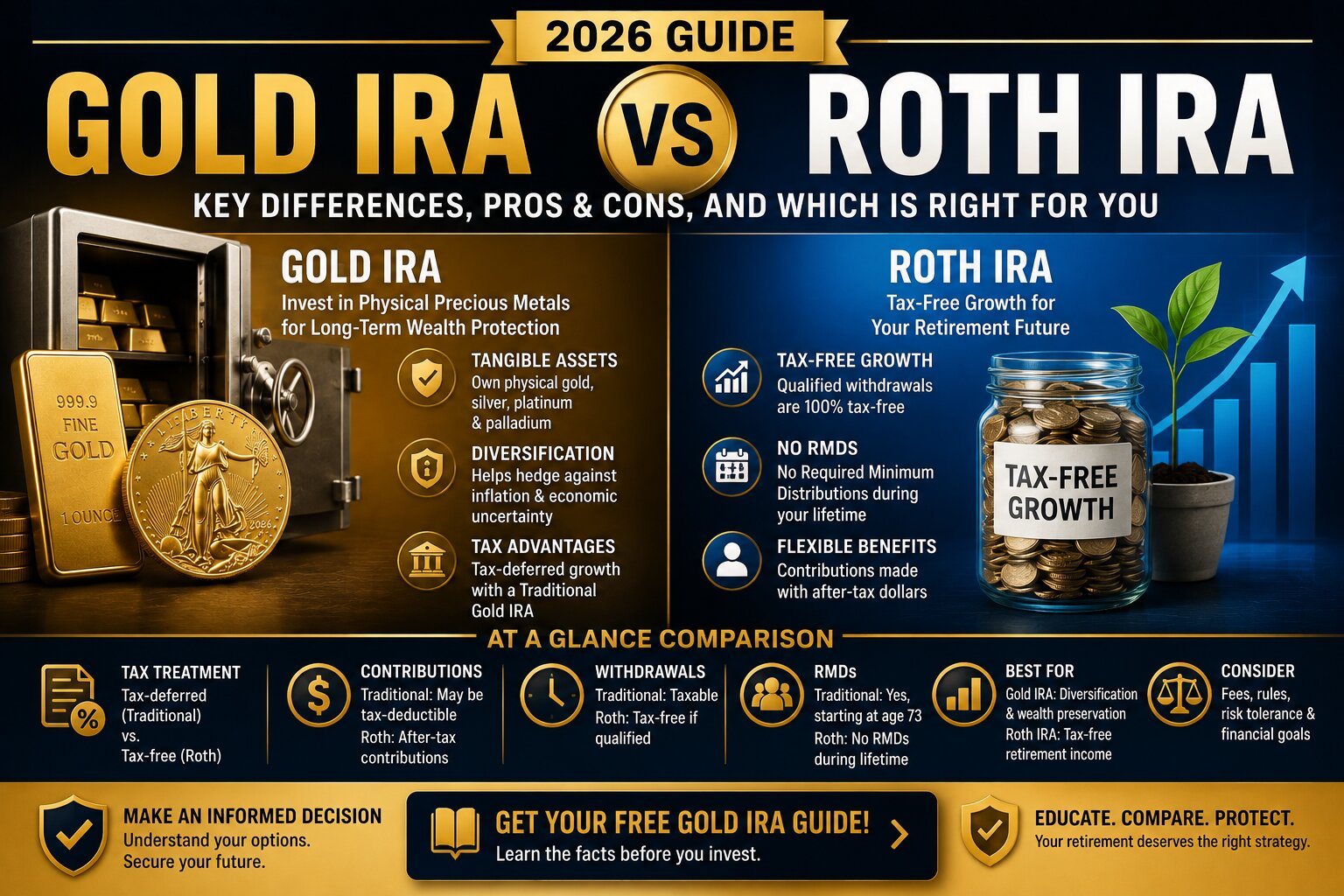
A Gold IRA vs Roth IRA comparison can be confusing because these terms describe two different aspects of retirement investing.
A Gold IRA generally refers to a self-directed individual retirement account used to hold certain qualifying physical precious metals.
A Roth IRA, meanwhile, describes a particular tax structure for an individual retirement account. Roth IRA contributions are generally made with after-tax money, and qualified distributions can be tax-free.
That creates an important distinction: a Gold IRA and a Roth IRA are not necessarily opposites. A self-directed IRA holding qualifying physical gold may potentially use either a traditional or Roth IRA structure when applicable requirements are satisfied.
For most investors, therefore, the real question is not simply “Gold IRA or Roth IRA?”
It is whether they want conventional investments, physical precious metals, traditional tax treatment, Roth tax treatment—or some combination appropriate for their retirement strategy.
This Gold IRA vs Roth IRA 2026 guide compares investment options, taxes, contribution limits, withdrawals, required minimum distributions, fees, liquidity and retirement-planning considerations.
Gold IRA vs Roth IRA: Quick Comparison
| Feature | Gold IRA | Roth IRA |
|---|---|---|
| What It Describes | IRA investing in qualifying physical precious metals | An IRA tax structure |
| Typical Investments | Qualifying gold, silver, platinum and palladium | Stocks, bonds, funds and other permitted investments depending on custodian |
| Tax Structure | Can depend on whether account is traditional or Roth | After-tax contributions; qualified distributions can be tax-free |
| 2026 IRA Contribution Limit | Generally subject to the combined IRA limit when funded by regular contributions | $7,500 combined IRA limit; $8,600 if age 50+ |
| Rollovers | Eligible retirement assets may potentially be rolled into an appropriate self-directed IRA | Certain retirement assets may potentially be converted or rolled to Roth, sometimes creating taxable income |
| Physical Storage | Applicable custody requirements apply to IRA bullion | Not relevant unless the Roth IRA itself holds qualifying physical metals |
| Lifetime RMDs for Original Owner | Depends on whether underlying IRA is traditional or Roth | No lifetime RMDs for original Roth IRA owner |
| Income Generation | Physical gold itself pays no dividends or interest | Depends on investments selected |
| Fees | May include custodian, storage and precious-metal transaction costs | Depends heavily on custodian and investments |
What Is a Gold IRA?
Before comparing Gold IRA vs Roth IRA, it is important to understand what a Gold IRA actually means.
A Gold IRA is commonly used to describe a self-directed IRA that can hold certain qualifying physical precious metals.
Federal law generally treats metals and coins as collectibles for IRA purposes, but provides exceptions for certain coins and qualifying gold, silver, platinum and palladium bullion when applicable requirements are satisfied.
Unlike purchasing gold personally and putting it in a home safe, IRA-owned precious metals must comply with retirement-account rules.
For qualifying bullion, applicable custody requirements also apply.
If you are new to the concept, start with our complete What Is a Gold IRA? guide.
What Is a Roth IRA?
A Roth IRA is an individual retirement account with a different tax structure from a traditional IRA.
Roth IRA contributions are made with after-tax dollars rather than being deducted simply because they were contributed to the account.
One of the Roth IRA’s major attractions is that qualified distributions can generally be received free from federal income tax when applicable requirements are met.
Original Roth IRA owners also do not have required minimum distributions during their lifetime under current federal rules.
Key Roth IRA Advantage
The Roth IRA can be particularly attractive to investors who value the possibility of qualified tax-free retirement withdrawals and no lifetime RMD requirement for the original account owner.
Gold IRA vs Roth IRA: The Most Important Difference
The biggest misconception surrounding Gold IRA vs Roth IRA is assuming they are two mutually exclusive account types.
They are not necessarily mutually exclusive.
“Gold” describes the type of asset held inside the IRA.
“Roth” describes the tax treatment of the IRA.
For example, an investor could potentially have:
- A conventional traditional IRA holding stocks and bonds
- A conventional Roth IRA holding stocks and funds
- A traditional self-directed IRA holding qualifying physical gold
- A Roth self-directed IRA holding qualifying physical gold
The availability of particular investments depends on the IRA provider or custodian and applicable federal rules.
Can a Gold IRA Be a Roth IRA?
Yes, a self-directed IRA designed to hold qualifying precious metals may potentially use a Roth structure.
This is commonly referred to as a Roth Gold IRA.
The account must still comply with Roth IRA rules as well as applicable rules governing IRA-owned precious metals.
This means an investor should consider two separate questions:
- Which tax structure is appropriate—traditional or Roth?
- Which investments should the IRA hold?
Those decisions should not automatically be treated as the same decision.
Gold IRA vs Roth IRA Tax Treatment
Taxes are one of the biggest considerations in a Gold IRA vs Roth IRA comparison.
But remember that a Gold IRA can potentially use either a traditional or Roth structure.
Traditional Gold IRA
A traditional Gold IRA generally follows traditional IRA tax rules.
Depending on the taxpayer’s circumstances, eligible traditional IRA contributions may be deductible.
Generally, amounts in a traditional IRA are not taxed until distributed, and taxable distributions are generally treated as ordinary income.
Roth IRA
Roth IRA contributions are made with after-tax dollars.
Qualified Roth IRA distributions can generally be received free of federal income tax when the applicable requirements are satisfied.
Gold IRA vs Roth IRA Contribution Limits for 2026
For 2026, the total amount an eligible individual can contribute across all traditional and Roth IRAs is generally limited to:
2026 IRA Contribution Limits
Under age 50: $7,500
Age 50 or older: $8,600
The $8,600 figure consists of the $7,500 regular IRA contribution limit plus a $1,100 catch-up contribution for eligible individuals age 50 or older.
Importantly, this is a combined limit across traditional and Roth IRAs. It is not a separate $7,500 limit for every IRA you own.
Also, rollover contributions generally do not count against the normal annual IRA contribution limit.
Roth IRA Income Limits
Another important difference is that the ability to make direct Roth IRA contributions is subject to income limitations.
This differs from simply owning an IRA or completing certain eligible retirement rollovers.
Because income thresholds can change from year to year and depend on filing status, investors should verify the current IRS limits when determining their eligibility to contribute directly to a Roth IRA.
Gold IRA vs Roth IRA Investment Options
Investment flexibility is another major difference in a typical Gold IRA vs Roth IRA comparison.
A conventional Roth IRA at a brokerage might provide access to:
- Individual stocks
- Bonds
- Mutual funds
- Exchange-traded funds
- Money-market investments
- Other investments offered by the custodian
A physical Gold IRA is specifically designed to provide access to certain qualifying physical precious metals through a self-directed IRA structure.
These can potentially include qualifying:
- Gold bullion
- Silver bullion
- Platinum bullion
- Palladium bullion
- Certain qualifying coins
Not every gold coin, collectible or precious-metal product is automatically eligible for an IRA.
Gold IRA vs Roth IRA: Diversification
A conventional Roth IRA can potentially be highly diversified because investors may spread their money among stocks, bonds, funds and other permitted assets.
A Gold IRA provides a different form of diversification by introducing physical precious metals.
Gold has different economic characteristics from shares of companies or bonds.
However, diversification does not mean putting an entire retirement portfolio into one alternative asset.
Holding too much of any single asset—including gold—can itself create concentration risk.
See our Gold IRA Pros and Cons guide for a balanced analysis of physical precious metals.
Gold IRA vs Roth IRA: Growth Potential
There is no single answer to which account offers greater growth because the return ultimately depends on the investments held inside the account.
Physical gold does not operate a business, generate earnings or pay dividends. Its investment return primarily depends on changes in the market value of the metal after considering purchase spreads and ownership costs.
A Roth IRA invested in equities can potentially benefit from:
- Business earnings growth
- Capital appreciation
- Dividend payments
- Compounding over long periods
Those investments can also decline significantly.
Therefore, investors should not assume either option automatically produces higher returns.
Gold IRA vs Roth IRA: Income and Dividends
This is one of the clearest differences between physical gold and many conventional investments.
Physical gold itself generates:
- No dividends
- No interest
- No corporate earnings
- No rental income
Stocks may pay dividends and bonds may pay interest.
Those cash flows can potentially be reinvested inside a Roth IRA.
Investors prioritizing income generation should consider this difference when evaluating Gold IRA vs Roth IRA.
Gold IRA vs Roth IRA Fees
Fees can materially affect long-term returns.
A physical Gold IRA may involve costs such as:
- Account setup fees
- Annual custodian or administration fees
- Precious-metal storage fees
- Transaction charges
- Dealer premiums or spreads
A conventional Roth IRA may have lower administrative costs depending on the brokerage and investments selected, although investment expense ratios, trading costs or advisory fees may still apply.
Read Gold IRA Fees Explained before comparing precious-metals providers.
Considering Physical Gold for Retirement?
Before moving retirement savings, learn how precious-metals IRAs work, what fees may apply and what questions to ask. Augusta offers a free educational Gold IRA guide that you can review before deciding whether physical gold fits your retirement strategy.
Affiliate link • Gold IRA Guide HQ may receive compensation from qualifying referrals.
Gold IRA vs Roth IRA Storage Requirements
Physical precious metals create a consideration that does not apply to ordinary stocks or mutual funds: physical custody.
IRS rules generally classify metals as collectibles, with exceptions for certain qualifying coins and bullion.
For qualifying bullion under the applicable exception, physical possession must be maintained by a bank or approved non-bank trustee.
This means investors should not assume that IRA-owned bullion can simply be purchased and kept in a personal home safe.
Read our Gold IRA Storage Rules guide before purchasing physical metals through an IRA.
Gold IRA vs Roth IRA Required Minimum Distributions
Required minimum distributions, or RMDs, are another major retirement-planning consideration.
For a traditional IRA, RMDs generally must begin by April 1 of the year following the year the owner reaches age 73 under current rules.
Original Roth IRA owners generally do not have to take lifetime required minimum distributions.
Gold IRA vs Roth IRA Withdrawal Rules
Withdrawal rules differ according to the underlying IRA structure.
Traditional IRA distributions of deductible contributions and earnings are generally taxable as ordinary income.
Roth IRA qualified distributions can generally be tax-free.
Early-distribution rules and exceptions can also apply depending on the circumstances.
Physical precious metals introduce another practical consideration: an investor may need to arrange liquidation or an appropriate distribution of the asset.
For additional tax information, read our Gold IRA Tax Rules.
Gold IRA vs Roth IRA Liquidity
A conventional Roth IRA holding publicly traded securities can generally offer relatively straightforward liquidity.
Stocks and ETFs can usually be sold electronically when markets are open.
Physical precious metals involve a different process.
Liquidating metals can involve the custodian, storage facility and precious-metals dealer.
Investors should understand:
- How metals are sold
- Who purchases them
- How long liquidation may take
- Whether liquidation charges apply
- The dealer’s current repurchase price
Gold IRA vs Roth IRA: Which Has More Risk?
Neither account is automatically “safe” or “risky.”
Risk comes largely from the investments, fees, portfolio allocation and investor behavior.
Physical gold carries risks including:
- Price volatility
- Dealer spreads
- Storage costs
- No investment income
- Potential over-allocation
Stocks and other market investments can carry:
- Market risk
- Business risk
- Interest-rate risk
- Economic risk
- Significant short-term volatility
A diversified portfolio may use different assets for different purposes rather than trying to identify one completely risk-free investment.
Gold IRA vs Roth IRA for Inflation
Some investors consider physical gold because they want an asset that behaves differently from cash, bonds or equities during certain economic environments.
Gold is frequently discussed as a potential inflation diversifier.
However, gold does not perfectly track inflation over every period, and there is no guarantee that its price will increase when consumer prices rise.
A Roth IRA, meanwhile, is an account structure rather than a specific asset.
Its inflation performance depends on what investments are held inside it.
A Roth IRA containing stocks, for example, has fundamentally different economic exposure from one holding cash-equivalent investments.
Gold IRA vs Roth IRA for Long-Term Retirement Growth
Investors with decades before retirement often prioritize long-term compounding.
Growth-oriented investments inside a Roth IRA can potentially compound without annual taxation inside the account, with qualified Roth distributions potentially being tax-free.
Physical gold can appreciate over time but does not generate earnings that are automatically reinvested.
This difference can be particularly important for younger investors with long investment horizons.
That does not mean gold has no role in a long-term portfolio.
It means investors should understand the different economic purpose each asset may serve.
Can You Have Both a Gold IRA and Roth IRA?
Yes.
An investor is not necessarily required to choose only one retirement strategy.
For example, someone could maintain a Roth IRA invested in diversified securities while separately maintaining a self-directed traditional IRA holding qualifying precious metals.
Alternatively, qualifying precious metals could potentially be held through a self-directed Roth IRA.
However, normal IRA contribution limits are generally aggregated across an individual’s traditional and Roth IRAs.
Owning multiple IRAs does not multiply the annual contribution limit.
What Is a Roth Gold IRA?
A Roth Gold IRA combines the Roth IRA tax structure with a self-directed IRA capable of holding qualifying physical precious metals.
The account is funded with after-tax Roth money, while qualified distributions can potentially be tax-free.
At the same time, the precious metals held inside the account must satisfy applicable IRA requirements.
A Roth Gold IRA therefore combines two sets of considerations:
- Roth IRA eligibility and tax rules
- Precious-metal eligibility and custody rules
Investors should understand both before establishing such an account.
Can You Convert a Traditional Gold IRA to a Roth Gold IRA?
A traditional IRA can potentially be converted to a Roth IRA, subject to applicable rules.
However, a Roth conversion can create current taxable income on amounts that have not previously been taxed.
That means a Roth conversion should not be undertaken merely because tax-free qualified withdrawals sound attractive.
Investors should evaluate:
- The potential current tax bill
- Current and expected future tax rates
- Time until retirement
- Cash available to pay conversion taxes
- Estate-planning objectives
- Overall retirement strategy
Consider discussing a significant Roth conversion with a qualified tax professional.
Gold IRA vs Roth IRA: Which Is Better for Beginners?
For beginners, simplicity matters.
A conventional Roth IRA at a brokerage can be relatively straightforward and may provide access to diversified, low-cost investments.
A physical Gold IRA generally requires investors to understand additional issues, including:
- Self-directed IRA administration
- Precious-metal eligibility
- Custodian requirements
- Storage arrangements
- Dealer pricing
- Buy/sell spreads
- Liquidation procedures
A beginner specifically seeking physical precious-metal exposure may still consider a Gold IRA, but should understand those additional layers first.
See our Best Gold IRA for Beginners guide for more information.
Gold IRA vs Roth IRA for Someone Near Retirement
Someone approaching retirement may evaluate the comparison differently from a 25-year-old investor.
Factors that become increasingly important include:
- Liquidity needs
- Expected retirement income
- Tax planning
- RMD requirements
- Portfolio volatility
- Asset diversification
- Legacy goals
For example, the absence of lifetime RMDs for an original Roth IRA owner can be an important planning feature.
Meanwhile, an investor may value some physical precious-metal exposure as part of a broader diversified portfolio.
The appropriate balance depends on individual circumstances.
Gold IRA vs Roth IRA Pros and Cons
| Option | Potential Pros | Potential Cons |
|---|---|---|
| Physical Gold IRA |
Physical precious-metal exposure Portfolio diversification Tangible asset IRA retirement structure |
Storage and custodian fees Dealer spreads No dividends or interest Additional rules and administration |
| Conventional Roth IRA |
Qualified tax-free distributions No lifetime RMDs for original owner Broad investment choices depending on provider Potential access to low-cost investments |
Direct contribution income limits No current deduction for Roth contributions Investment values can decline Tax rules must be followed for qualified distributions |
| Roth Gold IRA |
Physical precious metals Roth tax structure Qualified distributions can potentially be tax-free No lifetime RMDs for original owner |
Gold IRA costs Storage requirements Roth eligibility/tax rules Physical gold generates no income |
Gold IRA vs Roth IRA: Which Is Better?
There is no universal winner in the Gold IRA vs Roth IRA comparison because the terms answer different questions.
A Conventional Roth IRA May Appeal More If You:
- Want potential qualified tax-free retirement withdrawals
- Want broad access to stocks, funds and other conventional investments
- Prefer relatively simple account administration
- Want no lifetime RMDs as the original account owner
- Want access to investments that can generate dividends or interest
A Physical Gold IRA May Appeal More If You:
- Specifically want qualifying physical precious metals in retirement savings
- Want an alternative asset alongside conventional investments
- Understand precious-metal pricing and spreads
- Accept additional storage and custodian costs
- Are comfortable with self-directed IRA rules
A Roth Gold IRA May Be Worth Researching If You:
- Want qualifying physical precious metals
- Prefer a Roth tax structure
- Are eligible for the intended funding strategy
- Understand the tax consequences of any conversion
- Accept the additional costs associated with physical-metal ownership
Questions to Ask Before Choosing
Gold IRA vs Roth IRA Checklist
- What is my current marginal tax rate?
- What tax rate might I face in retirement?
- How long until I expect to retire?
- Do I want physical precious metals?
- How diversified is my existing portfolio?
- Do I need investments that produce income?
- How important is liquidity?
- Can I tolerate gold-price volatility?
- How much will Gold IRA fees cost?
- Do I understand the precious-metal buy/sell spread?
- Would a Roth conversion create a significant tax bill?
- Do I understand applicable storage requirements?
Common Gold IRA vs Roth IRA Mistakes
Mistake #1: Thinking You Must Choose Only One
Investors can potentially use different retirement accounts and asset classes as part of a broader strategy.
Mistake #2: Assuming Gold Is Risk-Free
Gold prices can decline. A Gold IRA does not guarantee profits or protection from investment losses.
Mistake #3: Ignoring Gold IRA Fees
Storage, custodian costs and dealer spreads can materially affect returns.
Mistake #4: Ignoring Roth Conversion Taxes
Moving previously untaxed retirement assets into a Roth structure can potentially create taxable income.
Mistake #5: Assuming Every Gold Product Is IRA Eligible
Federal IRA rules provide exceptions for certain coins and qualifying bullion. Not every precious-metal product automatically qualifies.
Mistake #6: Over-Concentrating in One Asset
Neither gold nor stocks should automatically be viewed as an all-or-nothing retirement strategy.
Want to Learn How a Physical Gold IRA Works?
Before deciding between conventional retirement investments and physical precious metals, learn the Gold IRA process, costs and rollover rules. Augusta’s free educational guide can help you research the precious-metals side of the decision.
Affiliate disclosure: Gold IRA Guide HQ may receive compensation from qualifying referrals.
Gold IRA vs Roth IRA 2026: Final Verdict
The most important conclusion from our Gold IRA vs Roth IRA 2026 comparison is that these terms do not describe exactly the same thing.
A Gold IRA describes an IRA designed to hold certain qualifying physical precious metals.
A Roth IRA describes a retirement account with a particular tax structure.
That means an investor can potentially have a traditional Gold IRA, a conventional Roth IRA, or even a self-directed Roth IRA holding qualifying physical precious metals.
A conventional Roth IRA may be attractive for investors who value potential qualified tax-free withdrawals, no lifetime RMDs for the original owner and broad access to conventional investments.
A physical Gold IRA may be attractive to investors specifically seeking tangible precious-metal exposure and additional portfolio diversification.
But physical gold also introduces storage costs, dealer spreads, additional administration and no dividend or interest income.
Rather than asking only whether a Gold IRA vs Roth IRA is better, investors should ask two separate questions:
- Which tax structure best fits my retirement plan?
- Which investments best fit my portfolio?
Answering those questions separately can lead to a much more informed retirement decision.
Continue your research with our What Is a Gold IRA?, Gold IRA Rollover Guide, Gold IRA Tax Rules, Gold IRA Fees Explained, Gold IRA Storage Rules and Gold IRA Pros and Cons.