Gold IRA vs Physical Gold 2026: Which Is Better for You?
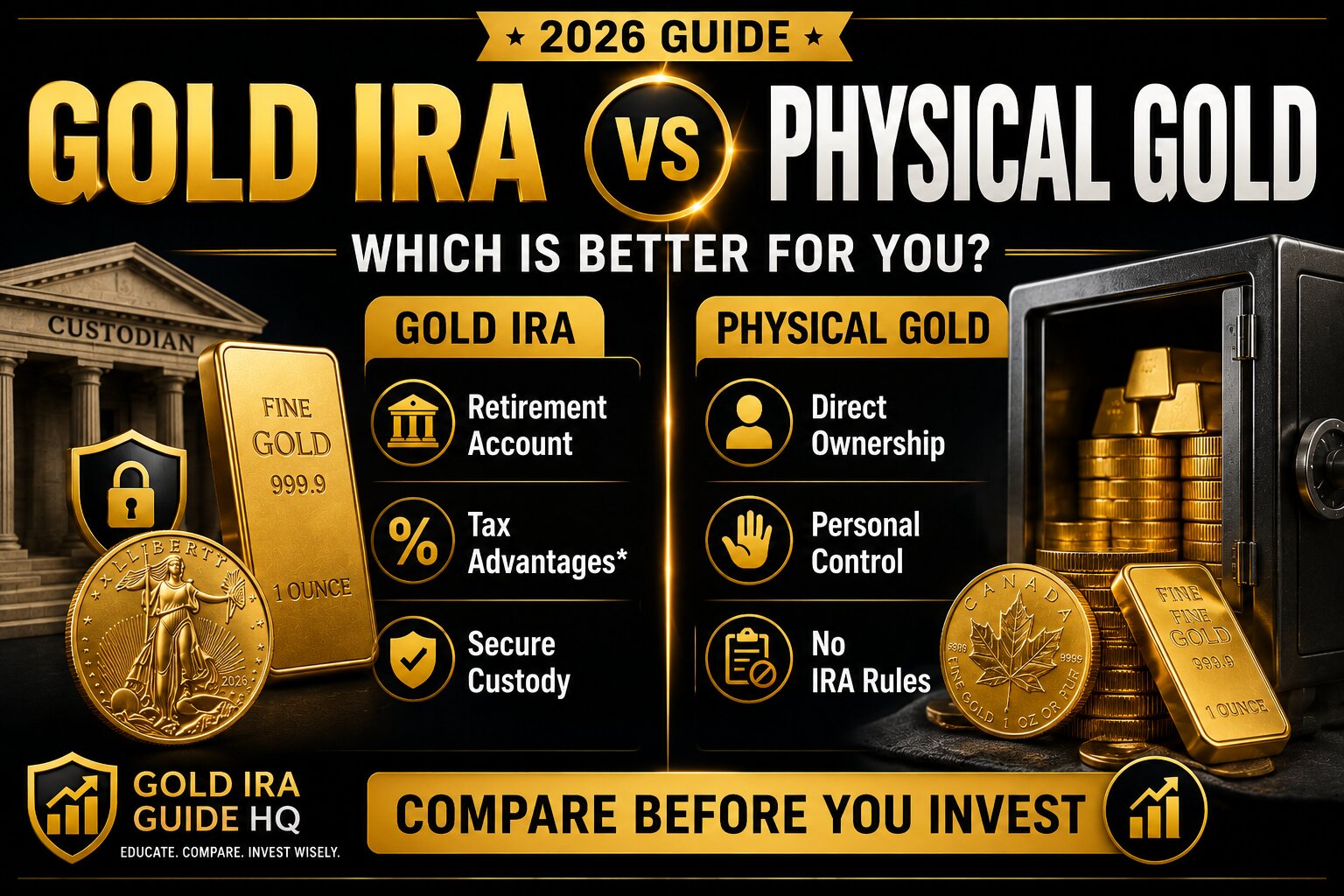
The Gold IRA vs Physical Gold decision is important for investors who want exposure to precious metals but are unsure whether gold should be held inside a retirement account or purchased directly.
Both approaches can give you exposure to physical gold, but the way the metal is owned, stored, taxed and accessed can be very different.
With a Gold IRA, qualifying physical precious metals are held within a self-directed individual retirement account and must follow applicable IRA rules. With personally owned physical gold, you purchase the metal directly and generally control how and where you store it.
This distinction affects taxes, storage, liquidity, fees, accessibility, retirement distributions and estate planning.
In this complete Gold IRA vs Physical Gold 2026 comparison, we’ll examine the advantages and disadvantages of both approaches so you can better understand which structure may fit your objectives.
Gold IRA vs Physical Gold: Quick Comparison
| Feature | Gold IRA | Personally Owned Physical Gold |
|---|---|---|
| Ownership Structure | Held inside a self-directed IRA | Owned personally |
| Tax Treatment | Depends on traditional or Roth IRA structure | Generally subject to normal tax rules for personally owned investment gold |
| Personal Possession | Qualifying IRA bullion is subject to specific custody requirements | Owner generally controls possession and storage |
| Annual IRA Fees | Custodian and storage fees may apply | No IRA custodian fee |
| Dealer Premium/Spread | Yes | Yes |
| IRA Contribution Rules | Yes | No |
| RMD Rules | Can apply when held in a traditional IRA | No IRA RMD rules |
| Access to Gold | Controlled through IRA/custody structure | Direct access when personally stored |
| Primary Purpose | Retirement investing | Direct personal ownership |
What Is a Gold IRA?
Before comparing Gold IRA vs Physical Gold, it helps to understand what a Gold IRA actually is.
A Gold IRA is commonly used to describe a self-directed individual retirement account that can hold certain qualifying physical precious metals.
Depending on applicable requirements, the account may hold certain qualifying:
- Gold coins
- Gold bullion
- Silver bullion
- Platinum bullion
- Palladium bullion
Not every coin, bar or collectible made from precious metal automatically qualifies for IRA ownership.
A Gold IRA can potentially use either a traditional or Roth tax structure.
If you’re new to these accounts, read our What Is a Gold IRA? guide before continuing.
What Is Personally Owned Physical Gold?
Personally owned physical gold is much simpler conceptually.
You purchase gold directly outside a retirement account and personally own the asset.
Common forms include:
- Gold bullion bars
- Government-minted bullion coins
- Privately minted rounds
- Some collectible or numismatic coins
Unlike IRA-owned gold, personally owned gold is not being held within an individual retirement account.
That means the owner generally decides how and where to store the metal, subject to applicable laws and practical security considerations.
Gold IRA vs Physical Gold: The Biggest Difference
The biggest difference between Gold IRA vs Physical Gold is not necessarily the metal itself.
It is the ownership structure.
Personal Physical Gold: you purchase and own the metal outside an IRA and generally control its possession and storage.
That one difference creates many of the tax, storage, access and administrative differences discussed throughout this guide.
Gold IRA vs Physical Gold Ownership
When you purchase physical gold personally, the asset belongs directly to you.
You can generally choose whether to keep it in a secure home location, private vault, safe-deposit arrangement where available, or third-party storage facility.
A Gold IRA works differently.
The precious metals are assets of the IRA, and qualifying bullion held under the applicable precious-metals exception is subject to specific physical-possession requirements.
This makes personal control one of the clearest differences in a Gold IRA vs Physical Gold comparison.
Can You Keep Gold IRA Metals at Home?
Investors should be particularly careful with claims about so-called “home storage Gold IRAs.”
Federal IRA rules generally treat metals as collectibles, but provide exceptions for certain qualifying coins and bullion.
For qualifying bullion under the applicable exception, the metal must be in the physical possession of a bank or an approved non-bank trustee.
That is fundamentally different from buying gold personally and putting it in your own safe.
Important Storage Distinction
If having immediate personal possession of your bullion is your primary objective, personally owned physical gold is fundamentally different from qualifying bullion held within an IRA.
Read our complete Gold IRA Storage Rules guide before establishing a precious-metals IRA.
Gold IRA vs Physical Gold Tax Treatment
Taxes are another major consideration when comparing Gold IRA vs Physical Gold.
A Gold IRA operates inside a tax-advantaged retirement-account structure.
The precise tax treatment depends on whether the self-directed IRA is structured as a traditional IRA or Roth IRA.
Traditional Gold IRA
A traditional Gold IRA generally follows traditional IRA tax rules. Investment gains generally remain tax-deferred while assets stay within the account, while taxable distributions are generally included in income when withdrawn.
Roth Gold IRA
A Roth Gold IRA uses the Roth IRA tax structure. Contributions are generally made with after-tax money, and qualified Roth distributions can potentially be received free of federal income tax when applicable requirements are satisfied.
Personally Owned Physical Gold
Personally owned investment gold is held outside the IRA system.
Selling physical gold for more than your tax basis can create a taxable gain. The specific federal tax treatment depends on factors including the nature of the asset and how long it was held.
Because individual circumstances vary, investors with significant physical-gold transactions should consider consulting a qualified tax professional.
For IRA-specific information, see our Gold IRA Tax Rules.
Gold IRA vs Physical Gold Contribution Limits
Another significant difference between Gold IRA vs Physical Gold is how much money can be added through regular contributions.
Personally owned physical gold has no IRA contribution limit because it is not being purchased inside an IRA.
You can generally purchase whatever amount you can legally and financially acquire.
Regular IRA contributions, however, are subject to annual federal limits.
2026 IRA Contribution Limit
Under age 50: $7,500
Age 50 or older: $8,600
These are combined limits across an individual’s traditional and Roth IRAs and are also subject to applicable compensation and eligibility rules.
Importantly, eligible rollover contributions do not count against the normal annual IRA contribution limit.
Can You Buy More Than $7,500 of Gold in a Gold IRA?
Potentially, yes.
The annual IRA contribution limit applies to regular contributions, but it does not mean a Gold IRA can never contain more than $7,500 worth of precious metals.
Investors may already have substantially larger balances in eligible retirement accounts.
Eligible retirement assets may potentially be transferred or rolled into an appropriate self-directed IRA when the transaction is completed correctly.
For example, someone with retirement savings in an eligible employer plan may potentially move some or all eligible assets through an appropriate rollover.
Read our Gold IRA Rollover Guide before moving retirement assets.
Gold IRA vs Physical Gold Storage
Storage is one of the most practical differences in the Gold IRA vs Physical Gold debate.
| Storage Factor | Gold IRA | Physical Gold |
|---|---|---|
| Personal Home Storage | Do not assume qualifying IRA bullion can be personally possessed | Generally possible for personally owned gold |
| Professional Vault | Common | Optional |
| Custodian Involvement | Yes | No IRA custodian required |
| Direct Access | Limited by IRA/custody structure | Possible with personal possession |
| Storage Costs | Generally applicable | Depends on storage choice |
Gold IRA vs Physical Gold Fees
Costs can materially affect investment returns.
Both IRA gold and personally owned gold can involve dealer premiums and buy/sell spreads.
However, a Gold IRA usually introduces additional account-related costs.
Potential Gold IRA Costs
- Account setup fees
- Annual custodian fees
- Administrative fees
- Storage fees
- Dealer premiums
- Buy/sell spreads
- Transaction charges
Potential Physical Gold Costs
- Dealer premium
- Buy/sell spread
- Shipping where applicable
- Insurance
- Private storage or vault fees if used
- Security costs for personal storage
Personally owned gold can therefore avoid IRA administration costs, but that does not make physical ownership cost-free.
Our Gold IRA Fees Explained guide examines precious-metals IRA expenses in greater detail.
Considering Gold for Your Retirement?
Before deciding between personally owned gold and a Gold IRA, learn how precious-metals IRAs work, what fees may apply and what questions to ask. Augusta offers a free educational Gold IRA guide you can review before making a retirement decision.
Affiliate link • Gold IRA Guide HQ may receive compensation from qualifying referrals.
Gold IRA vs Physical Gold: Access and Control
If direct control is important to you, personally owned gold has an obvious distinction.
When you personally possess bullion, you can physically access it without going through an IRA custodian.
Gold held within an IRA is different because retirement-account rules and custody arrangements apply.
That reduced personal access is not necessarily a disadvantage for everyone.
Some investors may actually prefer professional custody rather than being personally responsible for protecting valuable metals.
Others may specifically want immediate physical possession.
Your preference can strongly influence the Gold IRA vs Physical Gold decision.
Gold IRA vs Physical Gold Security
Security works differently under each approach.
Gold IRA Security
Gold IRA metals are generally held through professional custody and storage arrangements.
Investors should still investigate the custodian, storage facility, insurance arrangements and account procedures before investing.
Personally Owned Gold Security
When you personally possess gold, security becomes your responsibility.
Potential concerns include:
- Theft
- Loss
- Fire or natural disasters
- Disclosure of the storage location
- Insurance limitations
- Estate access after death
A high-quality safe or professional private vault may reduce some risks, but those measures can add costs.
Gold IRA vs Physical Gold Liquidity
Both types of physical gold can potentially be sold, but the process may differ.
Personally owned gold can generally be taken directly to a willing dealer or sold through another appropriate marketplace.
Gold inside an IRA generally requires coordination through the retirement-account structure.
Investors should understand:
- Who will purchase the metal?
- How is the repurchase price determined?
- What is the current spread?
- Are liquidation charges involved?
- How long does settlement take?
Never assume that a dealer’s original retail price is what the same dealer will pay when you sell.
Gold IRA vs Physical Gold Dealer Spreads
Dealer spreads matter under both approaches.
Suppose a dealer sells a gold product for one price but would immediately repurchase it for substantially less.
That difference means the market value of gold must increase before the investor breaks even on the transaction.
This is why investors should ask for both:
- The price they are being charged today
- The dealer’s current repurchase price for the same product
The comparison can reveal more about the true transaction cost than looking only at the advertised purchase price.
Gold IRA vs Physical Gold and Required Minimum Distributions
RMD rules can become important for Gold IRA owners.
A traditional self-directed IRA holding physical gold generally remains subject to traditional IRA distribution requirements.
Under current federal rules, traditional IRA owners generally begin RMDs for the year they reach age 73.
Personally owned physical gold is not an IRA, so IRA required minimum distribution rules do not apply to it.
How Can RMDs Affect a Gold IRA?
RMDs can create an additional planning issue when a retirement account owns physical assets.
With a conventional IRA holding liquid securities, investments can generally be sold to create cash for a distribution.
A physical Gold IRA may require the investor to coordinate a sale of some metals or arrange an appropriate in-kind distribution.
This makes liquidity planning particularly important for investors approaching RMD age.
Gold IRA vs Physical Gold for Retirement
If the primary objective is retirement investing, a Gold IRA offers one major structural distinction: the precious metals remain within an IRA.
That can allow retirement assets to maintain the applicable tax treatment of the underlying IRA when all requirements are followed.
Personally owned physical gold does not have that IRA structure.
On the other hand, direct physical ownership offers greater control and fewer retirement-account restrictions.
The appropriate choice therefore depends partly on why you want to own gold.
Gold IRA vs Physical Gold for Emergency Access
Personally owned physical gold provides greater direct access to the metal.
That can appeal to people who want tangible assets outside the financial and retirement-account system.
Gold inside an IRA should generally be viewed as a retirement asset rather than an emergency reserve.
Taking assets from an IRA can create tax consequences and potentially additional taxes depending on the account, investor’s age and circumstances.
Therefore, investors generally should not treat a Gold IRA as a substitute for an accessible emergency fund.
Gold IRA vs Physical Gold for Diversification
Both strategies can provide exposure to physical precious metals.
The diversification benefit therefore comes primarily from the asset itself, rather than whether the gold is held inside or outside an IRA.
However, where the gold is held can affect the overall structure of your wealth.
For example, an investor might hold:
- Stocks and bonds inside retirement accounts
- Some qualifying physical gold inside a self-directed IRA
- Some personally owned bullion outside retirement accounts
- Cash for near-term needs
There is no requirement that investors choose only one form of gold ownership.
Can You Own Both a Gold IRA and Physical Gold?
Yes.
An investor can potentially own personally held physical gold while also maintaining a self-directed IRA containing qualifying precious metals.
The two holdings should remain clearly separate.
Personally owned gold belongs to the individual.
IRA-owned gold belongs within the retirement-account structure and must follow applicable IRA requirements.
Investors should avoid mixing personal assets with IRA assets.
Gold IRA vs Physical Gold for Privacy
Some investors are attracted to physical gold because of the tangible and personally controlled nature of the asset.
However, investors should not assume that buying or selling physical gold is automatically anonymous or exempt from tax and reporting requirements.
Applicable dealer, tax and transaction requirements can depend on the nature and size of a transaction.
A Gold IRA also involves formal account administration and recordkeeping through the custodian.
Investors should comply with all applicable reporting and tax requirements regardless of which ownership method they choose.
Gold IRA vs Physical Gold: Which Costs Less?
Personally owned gold can have lower ongoing administrative expenses because there is no self-directed IRA custodian.
But the complete cost comparison depends on how the metal is purchased and stored.
Someone who stores personally owned gold in a professional insured vault may still incur ongoing storage costs.
Likewise, both types of buyers can pay dealer premiums and face spreads when selling.
Therefore, compare the total cost of ownership, not just one advertised fee.
Gold IRA vs Physical Gold: Which Gives You More Control?
Personally owned physical gold generally gives the investor more direct control.
You choose:
- What gold to buy
- Where to purchase it
- Where to store it
- When to access it
- When to sell it
A Gold IRA involves additional rules and intermediaries because the asset is inside a retirement account.
For investors who prioritize direct possession, personally owned bullion may therefore be more attractive.
For investors who prioritize keeping qualifying gold within a retirement-account structure, the Gold IRA may be more relevant.
Gold IRA vs Physical Gold: Which Is Simpler?
Buying physical gold personally is generally simpler from an account-structure perspective.
You select a dealer, purchase the metal and determine an appropriate storage arrangement.
A Gold IRA usually involves:
- Opening an appropriate self-directed IRA
- Funding the account
- Selecting qualifying precious metals
- Purchasing through the account
- Arranging compliant custody/storage
- Maintaining the IRA over time
Our How to Open a Gold IRA guide explains this process step by step.
Gold IRA vs Physical Gold: Pros and Cons
| Option | Potential Advantages | Potential Drawbacks |
|---|---|---|
| Gold IRA |
IRA retirement structure Physical precious-metal exposure Potential tax advantages depending on IRA type Professional custody Potential rollover funding |
Custodian fees Storage fees IRA rules No immediate personal possession of qualifying bullion Potential RMDs for traditional IRA structure |
| Physical Gold |
Direct ownership Greater personal control No IRA contribution limits No IRA RMD requirements Immediate access if personally stored |
No IRA tax shelter Personal security responsibility Possible storage/insurance costs Dealer spreads Tax consequences when sold at a gain |
Who Might Consider a Gold IRA?
A Gold IRA May Be Worth Researching If You:
- Want qualifying physical precious metals within retirement savings
- Have eligible retirement assets you may want to roll over
- Prefer professional custody rather than personal storage
- Understand self-directed IRA rules
- Are comfortable with custodian and storage fees
- Want gold as part of a longer-term retirement strategy
Who Might Prefer Personally Owned Physical Gold?
Physical Gold May Appeal More If You:
- Want direct personal ownership
- Want immediate physical access to your metals
- Do not want IRA restrictions
- Are purchasing gold with non-retirement money
- Are comfortable handling your own security and storage
- Understand the tax implications of personally owned investment gold
Could Owning Both Make Sense?
The Gold IRA vs Physical Gold decision does not necessarily have to be all-or-nothing.
Some investors may want retirement-account exposure to qualifying precious metals while also maintaining some personally owned bullion.
Each holding can serve a different purpose.
IRA gold may be intended for long-term retirement diversification.
Personally owned gold may appeal to investors who prioritize direct possession and control.
Whether either strategy is appropriate—and how much gold to own—depends on individual objectives, risk tolerance, time horizon, liquidity needs and overall portfolio composition.
Gold IRA vs Physical Gold for Beginners
Beginners should first determine why they want to own gold.
If the goal is simply to own a few gold coins or bars personally, opening a self-directed IRA may introduce unnecessary complexity.
If the goal is specifically to use retirement assets for qualifying physical precious-metal exposure, a Gold IRA becomes more relevant.
Before opening one, understand:
- IRA tax rules
- Eligible precious metals
- Storage requirements
- Custodian responsibilities
- Dealer pricing
- Annual fees
- Liquidation procedures
New investors can continue with our Best Gold IRA for Beginners guide.
Questions to Ask Before Choosing
Gold IRA vs Physical Gold Checklist
- Am I buying gold primarily for retirement?
- Am I using retirement money or personal savings?
- Do I want direct possession of the metal?
- How important are IRA tax advantages to me?
- Do I understand Gold IRA storage rules?
- What are the annual custodian fees?
- What are the storage fees?
- What premium am I paying over the relevant metal price?
- What is the dealer’s current repurchase price?
- How quickly could I liquidate the investment?
- How will personally owned gold be secured?
- Do I understand potential tax consequences?
- What percentage of my portfolio would be allocated to gold?
Common Gold IRA vs Physical Gold Mistakes
Mistake #1: Assuming Gold IRA Metals Can Simply Be Stored at Home
Investors should carefully review federal custody requirements rather than assuming IRA-owned bullion can be personally possessed.
Mistake #2: Ignoring Dealer Spreads
Dealer premiums and repurchase prices can materially affect your actual investment return.
Mistake #3: Assuming Physical Gold Has No Costs
Personally owned gold can still involve premiums, shipping, insurance, storage and security expenses.
Mistake #4: Treating Gold as Risk-Free
Gold prices fluctuate. Neither a Gold IRA nor personally owned physical gold guarantees profits.
Mistake #5: Ignoring Taxes
IRA distributions and sales of personally owned gold can have different tax consequences.
Mistake #6: Putting Too Much Retirement Money Into Gold
Concentrating retirement savings in a single asset can increase portfolio risk.
Mistake #7: Buying Before Comparing Companies
Compare dealer pricing, fees, storage arrangements, reputation and repurchase policies before committing significant retirement assets.
Also read our Gold IRA Scams to Avoid guide before choosing a provider.
Research a Gold IRA Before Moving Retirement Savings
If you are considering physical gold inside an IRA, understand the fees, custody rules, rollover process and dealer pricing first. Augusta’s free educational Gold IRA guide can help you learn how the process works before making a decision.
Affiliate disclosure: Gold IRA Guide HQ may receive compensation from qualifying referrals.
Gold IRA vs Physical Gold 2026: Final Verdict
There is no universal winner in the Gold IRA vs Physical Gold 2026 comparison.
Both approaches can provide exposure to physical precious metals, but they serve different purposes.
A Gold IRA may make more sense for someone who specifically wants qualifying physical precious metals within a retirement-account structure and is comfortable with custodian involvement, storage requirements and ongoing account fees.
Personally owned physical gold may make more sense for someone who values direct ownership, immediate access and greater control over storage.
However, personally owned gold does not receive IRA tax treatment simply because the asset itself is gold.
The decision therefore comes down to more than whether you believe gold is a good investment.
You also need to decide how you want to own it.
For some investors, using both approaches may be preferable to choosing only one. For others, conventional diversified retirement investments may remain the primary strategy with little or no physical gold exposure.
Before investing, compare costs, understand tax consequences, verify storage requirements and determine how gold fits within your overall retirement portfolio.
Continue your research with our What Is a Gold IRA?, Gold IRA Rollover Guide, Gold IRA Fees Explained, Gold IRA Storage Rules, Gold IRA Tax Rules, Gold IRA Pros and Cons and Best Gold IRA Companies.