Gold IRA Scams to Avoid in 2026: 12 Red Flags & How to Protect Your Retirement
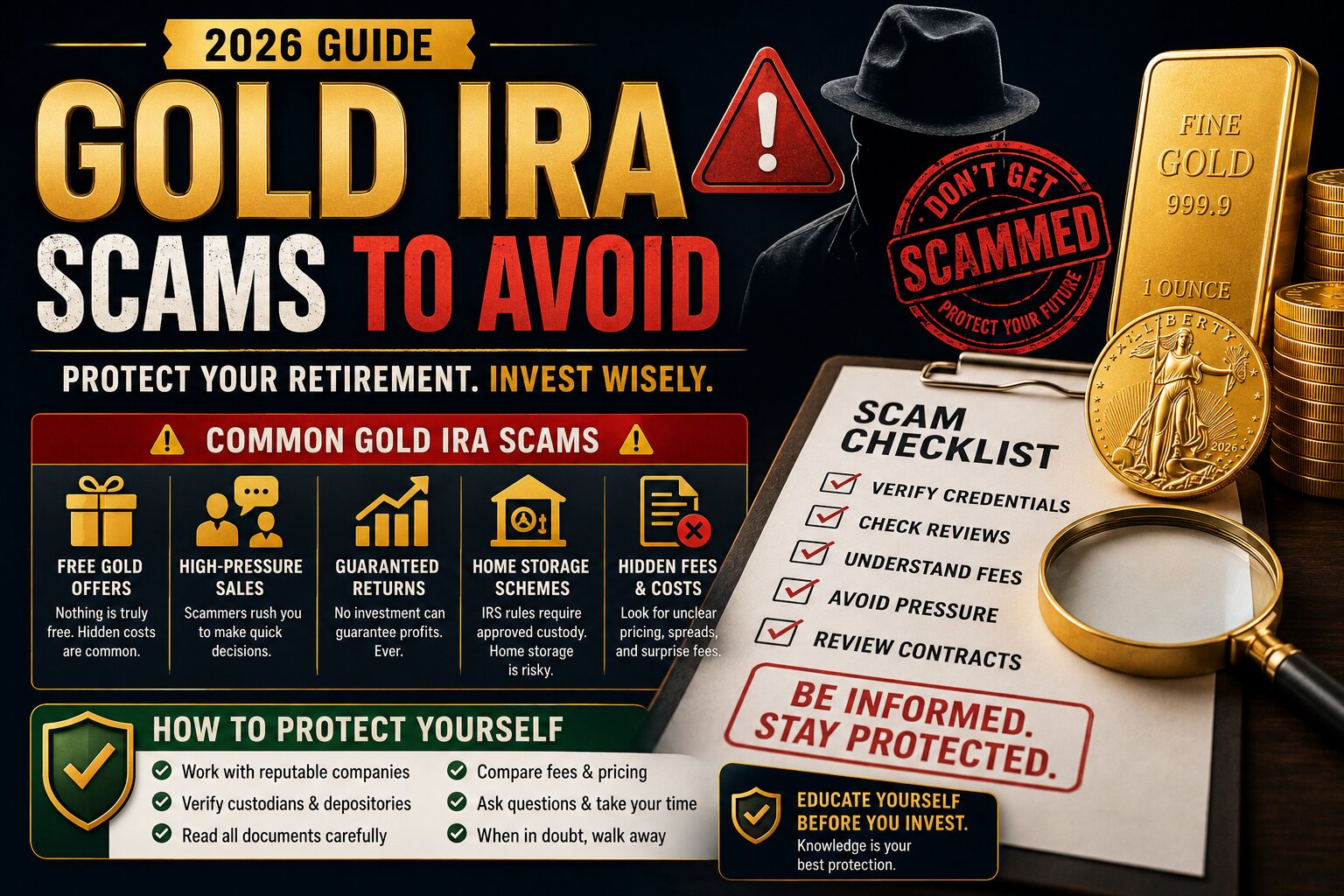
Learning about Gold IRA Scams to Avoid should be part of your research before transferring retirement savings to any precious-metals IRA.
Gold and other precious metals are legitimate assets, and self-directed IRAs can legitimately hold certain qualifying precious metals. However, the combination of retirement savings, physical assets and unfamiliar pricing can also create opportunities for misleading sales practices and outright fraud.
The Commodity Futures Trading Commission has warned that precious-metals fraudsters may target retirement savers and encourage them to move money into self-directed IRAs while selling metals at inflated prices or charging excessive fees.
That does not mean Gold IRAs themselves are scams.
It means investors need to distinguish a legitimate precious-metals IRA from misleading promotions, excessive markups, inappropriate products and fraudulent schemes.
This Gold IRA Scams to Avoid 2026 guide explains 12 major red flags and gives you a practical checklist you can use before moving retirement money.
Gold IRA Scams to Avoid: Quick Summary
- Be skeptical of anyone guaranteeing gold profits or claiming gold cannot lose value.
- Avoid making retirement decisions because of high-pressure or fear-based sales tactics.
- Ask for the exact purchase price and current repurchase price of metals.
- Watch for excessive markups on collectible, rare or specialized coins.
- Demand a complete written fee schedule before transferring retirement funds.
- Verify the actual IRA custodian instead of relying only on a dealer’s claims.
- Be cautious with home-storage Gold IRA promotions.
- Do not assume “free gold” means the transaction has no economic cost.
- Verify company information and independently research complaints or regulatory actions.
- Never send retirement money based solely on an unsolicited call, email or social-media message.
- Understand the difference between a dealer and a financial adviser.
- Never allow urgency to replace independent due diligence.
Are Gold IRAs a Scam?
No. A Gold IRA itself is not inherently a scam.
Federal tax law permits IRAs to hold certain qualifying coins and precious-metal bullion when applicable requirements are satisfied.
The problem is that legitimate investment structures can still be used in misleading or fraudulent sales schemes.
A scammer might use legitimate terminology such as “self-directed IRA,” “rollover,” “custodian” or “physical gold” while making false claims about pricing, risk or how retirement-account rules work.
If you’re unfamiliar with the basic structure, read What Is a Gold IRA? before evaluating individual companies.
Why Do Gold IRA Scams Target Retirement Investors?
Retirement accounts can contain decades of accumulated savings.
That makes them attractive targets for dishonest operators.
The CFTC warns that precious-metals fraudsters often target senior citizens and pre-retirement investors and may try to persuade them to move retirement savings into self-directed IRAs.
The sales pitch can become particularly effective when it combines financial fear with promises of safety.
An investor worried about inflation, banking problems, stock-market volatility or economic uncertainty may be more receptive to statements suggesting that gold is the only safe option.
That is why understanding Gold IRA Scams to Avoid is particularly important before responding to fear-based advertising.
12 Gold IRA Scams and Red Flags to Avoid
Red Flag #1: Guaranteed Gold IRA Returns
Be extremely skeptical if a salesperson guarantees that gold will rise by a specific amount or promises that you cannot lose money.
Gold is a market-priced asset.
Its value can rise or fall.
No legitimate dealer can control the future market price of gold.
Claims such as “guaranteed profits,” “risk-free returns” or “gold can only go up” should immediately trigger additional scrutiny.
Red Flag #2: High-Pressure Sales Tactics
A major warning sign is pressure to act immediately.
You might hear statements such as:
- “You have to transfer your IRA today.”
- “This opportunity expires tonight.”
- “Gold prices are about to explode.”
- “You need to get out of the stock market immediately.”
- “This special price is available only during this call.”
Retirement decisions can have long-term consequences.
A reputable provider should allow you time to review pricing, fees, disclosures and alternatives before committing.
Red Flag #3: Fear-Based Retirement Marketing
Fear can be a powerful sales tool.
Be cautious when a company attempts to convince you that financial collapse, bank failure, currency destruction or government action is virtually certain and that purchasing gold immediately is your only protection.
Economic risks can be legitimate topics for discussion.
The warning sign appears when uncertainty is presented as certainty in order to pressure you into an immediate transaction.
Red Flag #4: Hidden Precious-Metal Markups
One of the biggest financial risks in a precious-metals transaction is paying far more for a product than you realize.
A dealer’s selling price can exceed the underlying value of the metal.
The difference can reflect normal business costs and dealer profit, but excessive or undisclosed markups can seriously damage an investor’s returns.
Before purchasing, ask two questions:
- What exact price am I paying for this product today?
- What would you pay me today if I sold the same product back to you?
The difference can help you understand the immediate buy/sell spread.
Red Flag #5: Being Pushed Into Expensive Collectible Coins
Investors should pay particular attention when a salesperson aggressively pushes rare, collectible, numismatic or “exclusive” coins.
The CFTC warns that numismatic coins can carry significantly higher markups than bullion and may be less liquid.
There is also an IRA eligibility issue.
Federal law generally treats coins and metals as collectibles, subject to specific exceptions for qualifying coins and bullion.
Never assume a product is appropriate for an IRA merely because a salesperson calls it an “IRA coin.”
Red Flag #6: Hidden Gold IRA Fees
A Gold IRA can involve several different costs.
Potential charges include:
- Account setup fees
- Custodian fees
- Annual administration fees
- Storage charges
- Transaction fees
- Shipping charges
- Insurance-related costs
- Dealer markups or spreads
A company should be willing to explain what you will pay.
Our Gold IRA Fees Explained guide covers these costs in greater detail.
Red Flag #7: Misleading “Free Gold” Offers
“Free gold” can sound attractive.
But investors should ask how the promotion is funded.
Businesses need to cover promotional costs somehow.
The economic cost may potentially be reflected elsewhere in product pricing, spreads, minimum purchase requirements or other terms.
This does not mean every promotional offer is deceptive.
It means you should compare the total transaction rather than focusing on the word “free.”
Red Flag #8: Home Storage Gold IRA Claims
Be especially cautious if someone claims that you can simply use IRA money to buy bullion and personally keep the metals in your home safe.
IRS guidance states that the exception for certain qualifying bullion requires physical possession by a bank or an IRS-approved non-bank trustee.
The IRS also says this requirement applies to indirect arrangements such as an IRA-owned LLC purchasing the bullion.
Read our Gold IRA Storage Rules before considering any home-storage arrangement.
Red Flag #9: Unclear or Unverifiable Custodian Information
The precious-metals dealer and the IRA custodian are not necessarily the same entity.
Ask for the exact legal name of the institution administering your IRA.
If a non-bank trustee or custodian is involved, investors can review the IRS list of approved non-bank trustees and custodians.
Never send retirement funds merely because a salesperson says everything has been “IRS approved.”
Red Flag #10: Unsolicited Calls, Emails or Messages
Be cautious when an investment relationship begins with an unexpected phone call, email, direct message or social-media promotion.
The CFTC specifically warns investors about unsolicited precious-metals promotions.
Never provide sensitive financial or retirement-account information simply because a caller sounds knowledgeable.
Research the company independently using contact information you obtain yourself.
Red Flag #11: Fake Celebrity or Authority Endorsements
A familiar face does not prove that an investment is legitimate.
Fraudulent advertising can misuse images, names or endorsements to create trust.
Modern AI-generated images, audio and video also make fabricated endorsements easier to create.
Never choose a Gold IRA provider solely because an advertisement appears to feature a celebrity, commentator or public figure.
Red Flag #12: A Salesperson Acting Like Your Financial Adviser
A precious-metals salesperson may understand the products their company sells, but that does not automatically make the person your fiduciary financial adviser.
The CFTC warns that precious-metals salespeople may not be qualified or legally permitted to provide personalized investment advice.
Be cautious if a salesperson tells you exactly how much of your retirement portfolio to liquidate without conducting a legitimate assessment of your broader financial circumstances.
For major retirement allocation decisions, consider obtaining independent advice from an appropriately qualified professional.
Gold IRA Scam vs Legitimate Company: Warning Signs
| Warning Sign | More Responsible Practice |
|---|---|
| Guaranteed returns | Acknowledges that gold prices can rise or fall |
| Pressure to buy immediately | Allows time for research |
| Hidden pricing | Explains product pricing before purchase |
| Unclear fees | Provides understandable fee information |
| Fear-based certainty | Discusses risks without guaranteeing outcomes |
| Unverifiable custodian | Clearly identifies account administrator |
| Home-storage promises | Explains applicable IRA custody requirements |
| Pushes one product only | Explains product choices and differences |
| Refuses written information | Provides documentation for review |
| Promises risk-free gold | Discloses that precious metals fluctuate in value |
Educate Yourself Before Moving Retirement Money
Augusta’s free educational Gold IRA guide can help you learn more about precious metals and the Gold IRA process before deciding whether a rollover is appropriate for you.
Affiliate link • Gold IRA Guide HQ may receive compensation from qualifying referrals.
How Hidden Gold IRA Markups Can Hurt Investors
Pricing deserves special attention when researching Gold IRA Scams to Avoid.
Imagine an investor pays $50,000 for precious metals.
If the dealer would immediately repurchase those same metals for only $40,000, the investor begins with a $10,000 economic gap.
In this simplified example, the underlying metals would need to appreciate by 25% from the $40,000 repurchase value just for that value to reach the original $50,000 purchase cost.
This is why investors should never evaluate precious-metals transactions solely by looking at the amount transferred from an IRA.
Ask what you are receiving and what it is worth in a current resale transaction.
Are Collectible Gold Coins a Scam?
No. Collectible coins are not inherently scams.
There is a legitimate market for rare and numismatic coins.
The concern arises when retirement investors are sold high-premium collectible products without understanding their pricing, liquidity or IRA eligibility.
The CFTC warns that numismatic coins can carry higher markups than bullion and may be harder to resell at the expected value.
For a retirement investor primarily seeking exposure to precious-metal value, it is important to understand exactly why a particular high-premium product is being recommended.
Are Gold IRA “Free Silver” Promotions Scams?
Not necessarily.
A promotional incentive does not automatically mean the company is fraudulent.
But “free” should never stop you from doing the math.
Ask:
- How much must I invest to qualify?
- What exact metals will I receive?
- What is their retail value?
- What is their current repurchase value?
- Are the promotional costs reflected in the price of other metals?
- Does accepting the promotion affect any other terms?
Compare the entire transaction rather than the headline value of the incentive.
Home Storage Gold IRA Scams and Misleading Claims
Home-storage claims deserve particular attention because they involve both marketing risk and tax-compliance risk.
IRS guidance states that certain highly refined bullion qualifies for an exception from the IRA collectibles rules when it is physically possessed by a bank or an IRS-approved non-bank trustee.
The IRS specifically notes that the rule also applies to indirect arrangements such as an IRA-owned LLC purchasing the bullion.
That does not mean every discussion of an LLC is fraudulent.
But any promoter making broad promises that you can personally keep IRA bullion at home with no compliance concerns should be scrutinized carefully.
Read Gold IRA Storage Rules 2026 before proceeding with such an arrangement.
Gold IRA Rollover Scams to Avoid
A retirement rollover can involve a substantial amount of money.
That makes the rollover stage particularly important.
Watch for anyone who:
- Pressures you to liquidate your retirement plan immediately
- Claims all of your current retirement investments are unsafe
- Does not explain whether your distribution is eligible for rollover
- Encourages you to ignore tax consequences
- Cannot clearly identify the receiving custodian
- Promises that every type of retirement-account movement is tax-free
A properly executed eligible rollover can generally move retirement assets without current taxation, but rollover requirements still matter.
Read our Gold IRA Rollover Guide before transferring retirement funds.
Verify the Gold IRA Custodian
Do not confuse the company selling precious metals with the institution administering the IRA.
Ask the provider:
- Who is my IRA custodian?
- What is the custodian’s legal name?
- How can I contact the custodian directly?
- Where will account statements come from?
- Where will the metals be held?
The IRS maintains information about approved non-bank trustees and custodians.
Use independent sources rather than relying solely on a salesperson’s explanation.
Check Gold IRA Pricing Before You Buy
One of the best defenses against problematic precious-metals transactions is simple price transparency.
Ask for These Numbers in Writing
- Exact product name
- Quantity
- Weight
- Purity or fineness
- Price per coin or bar
- Total purchase price
- Spot-price reference, if relevant
- Dealer premium or markup, if disclosed
- Current dealer repurchase price
- Custodian fees
- Storage fees
- Shipping or transaction charges
If you cannot understand how much you’re paying and what you’re receiving, do not rush into the transaction.
Check the Company’s Reputation Independently
Online reviews can be useful, but they should not be your only source of information.
When evaluating a Gold IRA provider:
- Search the company’s legal name.
- Look for regulatory actions.
- Search for lawsuits or enforcement actions where relevant.
- Review customer complaints for recurring patterns.
- Verify the company’s physical contact information.
- Research the people operating the business.
- Read both positive and negative reviews.
A polished website or large number of positive reviews should not replace independent due diligence.
Be Careful With Gold IRA Reviews Online
This point is important for our own readers as well.
Many websites reviewing Gold IRA companies—including affiliate-supported websites—may receive compensation when readers become customers.
Compensation does not automatically make a review inaccurate, but the relationship should be disclosed clearly.
Readers should compare multiple sources and verify important claims independently.
Never Confuse Gold With a Guaranteed Safe Investment
Gold is often described as a safe-haven asset.
That phrase does not mean the price cannot fall.
The CFTC specifically warns investors not to confuse precious metals’ different economic behavior with being low-risk or guaranteed safe.
Physical gold also does not pay dividends or interest.
Transaction costs, storage expenses and dealer spreads can further affect returns.
These are among the reasons we discuss both sides in our Gold IRA Pros and Cons guide.
What to Do Before Signing a Gold IRA Agreement
✓ Step 1: Slow Down
Do not allow a salesperson to create an artificial deadline for a major retirement decision.
✓ Step 2: Get the Fees in Writing
Request the setup, annual, storage, transaction and other applicable fees before transferring money.
✓ Step 3: Compare Metal Prices
Understand the purchase price and current repurchase price of the products being recommended.
✓ Step 4: Verify the Custodian
Know which institution will actually administer your retirement account.
✓ Step 5: Understand Storage
Verify where your metals will be held and understand the applicable custody arrangement.
✓ Step 6: Review the Rollover
Understand whether the retirement-account movement qualifies as a rollover or transfer and what rules apply.
✓ Step 7: Compare Multiple Providers
Do not assume the first company you speak with offers the best pricing, service or terms.
Questions to Ask Before Choosing a Gold IRA Company
- What is your company’s full legal name?
- How long has the business operated?
- Who is the IRA custodian?
- Where will my metals be stored?
- What are all first-year fees?
- What are the recurring annual fees?
- What exact metals are you recommending?
- Why are you recommending these products?
- What is today’s purchase price?
- What would you pay today to repurchase the same metals?
- Do you guarantee buybacks? If so, where are the written terms?
- What happens if I want to liquidate?
- How long does liquidation typically take?
- Are there additional transaction or shipping fees?
- Can I review everything before making a decision?
Official Resources for Avoiding Gold IRA Scams
Investors researching Gold IRA Scams to Avoid should use independent government and regulatory resources in addition to company marketing.
The CFTC Precious Metals Fraud Resource explains common precious-metals fraud tactics and investor warning signs.
The FTC Investment Scams Guide provides broader guidance on recognizing investment fraud.
For IRA-specific rules, review the IRS IRA FAQs.
These outbound links are intentionally direct, followable links to government sources.
Research Before You Rollover
Before transferring retirement savings, understand how Gold IRAs work, compare providers and ask questions about fees, pricing, custody and storage. Augusta’s free educational guide is one resource you can review as part of that research.
Affiliate disclosure: Gold IRA Guide HQ may receive compensation from qualifying referrals.
Gold IRA Scams to Avoid in 2026: Final Thoughts
The best protection against Gold IRA Scams to Avoid is not avoiding precious metals entirely—it is understanding what you are buying, who you are dealing with and how the transaction works.
Gold IRAs can legitimately hold certain qualifying precious metals within an IRA structure, but that legitimacy should never be used as a reason to skip due diligence.
Watch carefully for guaranteed-return claims, fear-based selling, excessive markups, unclear fees, aggressive collectible-coin pitches, questionable home-storage claims and pressure to transfer retirement savings immediately.
Most importantly, compare the price you are paying with the amount the dealer would currently pay to buy the same metals back.
That simple question can reveal important information about the economics of the transaction.
You should also independently verify the custodian, understand storage arrangements and review applicable IRA rules before moving retirement money.
Never let a salesperson’s urgency determine the timing of a major retirement decision.
Continue your research with our Gold IRA Pros and Cons, Gold IRA Fees Explained, Gold IRA Tax Rules, Gold IRA Storage Rules, Gold IRA Rollover Guide and Best Gold IRA Companies.