Gold IRA Fees Explained 2026: Complete Guide to Costs & Charges
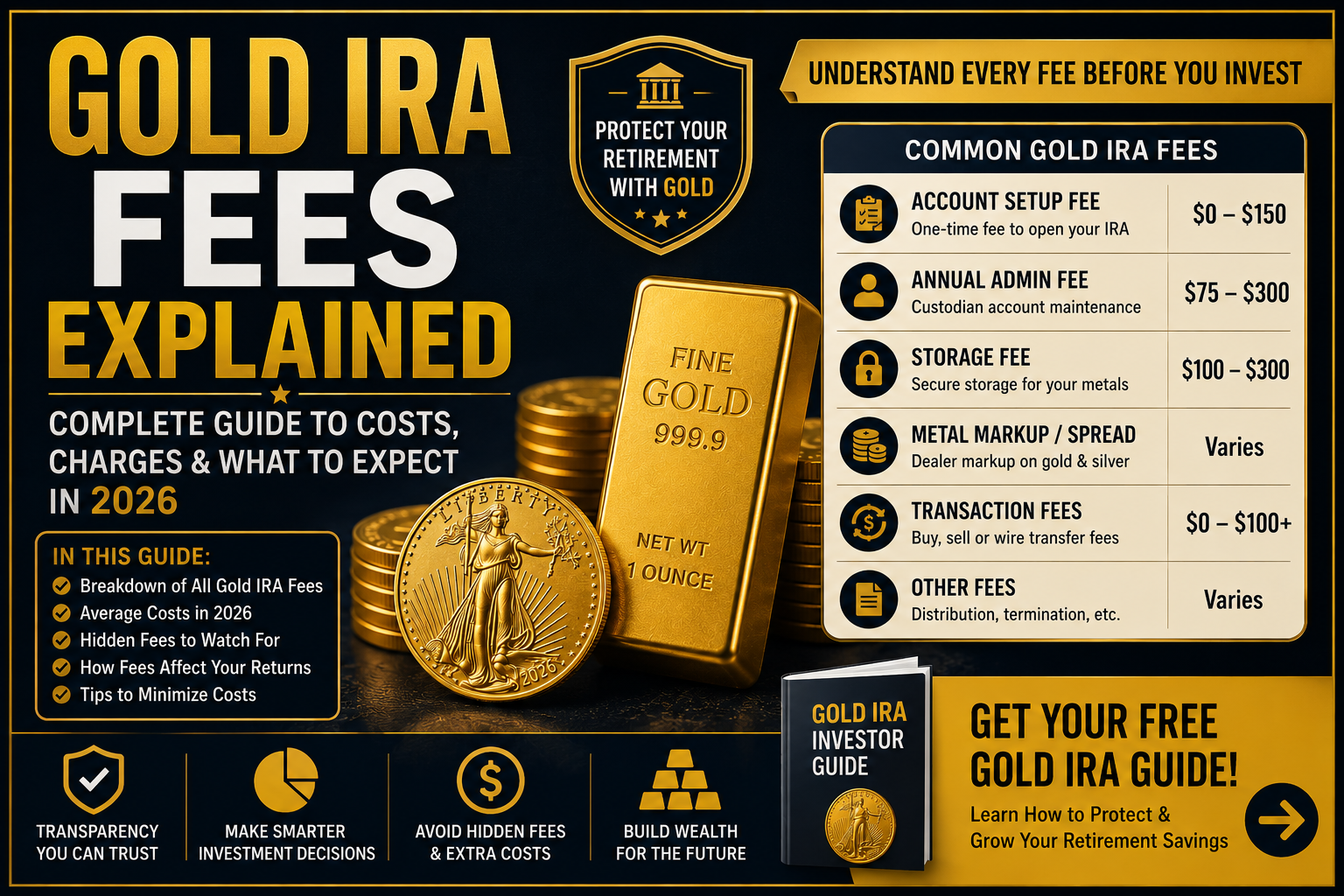
Understanding Gold IRA fees is one of the most important steps before moving retirement savings into physical precious metals.
Unlike many conventional brokerage IRAs, a physical Gold IRA can involve several different parties. Depending on the arrangement, you may encounter custodian or administration fees, storage costs, transaction charges and the cost built into buying and selling physical precious metals.
This Gold IRA Fees Explained guide breaks down the major costs investors should investigate in 2026, including account setup fees, annual administration, precious metals storage, dealer spreads and possible transaction or distribution charges.
Most importantly, we’ll explain why the cheapest advertised annual fee does not necessarily mean the lowest overall cost.
If you are completely new to these accounts, start with our What Is a Gold IRA? guide before examining the costs below.
Gold IRA Fees Explained: Quick Summary
A physical Gold IRA may involve several categories of costs:
- Account setup or establishment fees
- Annual custodian or administration fees
- Precious metals storage fees
- Dealer premiums and spreads
- Purchase or sale transaction charges, where applicable
- Wire, transfer or processing charges, where applicable
- Distribution or account-termination charges, where applicable
There is no single universal Gold IRA fee schedule. Exact costs depend on the custodian, depository, dealer, account size, metals selected and transaction structure.
What Are Gold IRA Fees?
Gold IRA fees are the various costs associated with establishing, administering, storing and transacting within an IRA that owns qualifying physical precious metals.
The structure is different from buying a gold ETF inside a conventional brokerage account.
Physical precious metals require custody and storage arrangements, and the investor also purchases actual coins or bars through a precious metals dealer.
This creates multiple potential cost layers.
When researching Gold IRA fees in 2026, it helps to separate account-level charges from investment-level costs.
| Fee / Cost | What It Covers | Frequency |
|---|---|---|
| Account Setup | Establishing and processing the IRA | Usually one-time if charged |
| Administration / Custodian | Maintaining and administering the retirement account | Usually annual |
| Storage | Storage and safeguarding of physical precious metals | Usually annual |
| Metal Premium / Spread | Difference associated with dealer purchase and liquidation pricing | When buying or selling |
| Transaction Charges | Purchases, sales or other transactions where applicable | Per transaction |
| Wire / Processing | Payment or administrative processing where applicable | As incurred |
| Distribution / Closure | Processing distributions or closing an account where applicable | When applicable |
1. Gold IRA Account Setup Fees
What Is an Account Setup Fee?
Some self-directed IRA custodians charge a one-time fee when a new account is established.
The exact charge varies by provider, and some companies or promotional arrangements may waive or reimburse certain setup costs.
An account setup fee generally covers the administrative work involved in opening the retirement account and processing the initial documentation.
Before opening an account, ask:
- Is there an account establishment fee?
- Is it charged by the dealer or custodian?
- Is it a one-time charge?
- Can it be waived?
- Does a promotional offer reimburse the fee?
Our Gold IRA Fees Explained recommendation is simple: request the complete fee schedule before transferring retirement money.
2. Annual Gold IRA Custodian Fees
A physical precious metals IRA requires administration by an appropriate IRA custodian or trustee.
The annual administrative charge may cover recordkeeping, account statements, tax reporting and other custodial services.
Custodians can use different pricing models.
Flat Annual Fees
A flat-fee structure charges a specified amount regardless of the account value, subject to the custodian’s terms.
Asset-Based Fees
Some arrangements may calculate fees partly according to account value.
This distinction becomes more important as account size increases.
3. Gold IRA Storage Fees
Storage is another important component of Gold IRA fees.
Physical precious metals held within an IRA involve custody requirements that differ from personally buying gold and keeping it at home.
The IRS explains that certain qualifying gold, silver, platinum and palladium bullion can fall within the precious-metals exception to the collectibles rules when applicable requirements are satisfied, including physical possession by a bank or approved non-bank trustee for qualifying bullion.
Storage charges can depend on:
- The depository
- Account size
- Type of storage arrangement
- Custodian pricing
- Promotional fee arrangements
Segregated vs Non-Segregated Storage
When comparing storage costs, ask whether the metals are held under a segregated or other available storage arrangement and what that distinction means at the specific depository.
Do not assume that every Gold IRA provider uses the same terminology or pricing.
4. Precious Metals Premiums
This may be more economically important than the account’s annual administrative fee.
When purchasing physical gold, you generally do not buy every coin or bar at the raw spot price of gold.
The dealer’s quoted price may reflect wholesale costs, product-specific premiums, market conditions and the dealer’s margin.
Different precious metals products can carry very different premiums.
For example, the economics of buying a commonly traded bullion product may differ from purchasing a specialty or higher-premium coin.
5. The Gold IRA Dealer Spread
One of the most important concepts in our Gold IRA Fees Explained guide is the dealer spread.
The spread can be understood by comparing what you must pay to purchase a particular precious metal product with what the dealer would pay to buy that same product back.
Consider a simplified hypothetical example.
Dealer selling price: $10,500
Immediate dealer repurchase price: $9,500
The $1,000 difference demonstrates why investors should evaluate both sides of a precious metals transaction rather than looking only at the advertised annual IRA fee.
This is only an illustration, not a statement about any particular dealer’s pricing.
Actual spreads vary by company, product and market conditions.
Questions to Ask About Precious Metals Pricing
Before authorizing a Gold IRA purchase, ask the dealer:
- What is the exact dollar price of this coin or bar?
- What is the current spot price of the underlying metal?
- How much am I paying above the relevant metal value?
- What would you pay to repurchase this exact product today?
- Is the repurchase price guaranteed?
- Does the price change before settlement?
Compare Before Opening a Gold IRA
Before moving retirement savings, learn how Gold IRAs work and compare fees, precious metals pricing, storage and company service. Augusta offers a free educational Gold IRA guide as one starting point for your research.
Affiliate link • Gold IRA Guide HQ may receive compensation from qualifying referrals.
6. Gold IRA Transaction Fees
Depending on the custodian and account arrangement, additional charges may apply when transactions occur.
Potential examples include:
- Purchase processing charges
- Sale processing charges
- Wire fees
- Transfer fees
- Check fees
- Other administrative processing charges
These charges are not universal.
That is why a proper Gold IRA fees comparison should use each provider’s current written fee schedule rather than assuming every company charges the same amount.
7. Gold IRA Distribution & Account Closure Fees
Investors often focus on what it costs to open a Gold IRA while forgetting to ask what it costs to eventually leave.
Depending on the custodian and transaction, there may be costs associated with selling assets, processing distributions, transferring the account or closing it.
Ask about these costs before opening the account—not when you are ready to exit.
Are There Hidden Gold IRA Fees?
The phrase “hidden fees” is often used loosely.
Instead of assuming a company is hiding something, focus on identifying every economic cost before approving the transaction.
Potentially overlooked costs can include:
- Dealer premiums
- Bid/ask or buy/sell spreads
- Storage upgrades
- Wire charges
- Transaction charges
- Distribution processing
- Account termination costs
The most effective way to avoid surprises is to request written pricing from both the precious metals dealer and the IRA custodian.
Gold IRA Fees vs Regular IRA Fees
Physical precious metals IRAs can have a more complicated cost structure than many conventional brokerage IRAs.
| Cost | Physical Gold IRA | Typical Brokerage IRA |
|---|---|---|
| Custodian / Administration | May apply | May be low or waived depending on broker |
| Physical Storage | Generally relevant | Not applicable to ordinary securities |
| Dealer Premium / Spread | Relevant to physical metals | Not applicable in the same form |
| Trading Costs | Depends on dealer/custodian | Depends on broker and investment |
| Physical Distribution | Potentially available subject to IRA rules and processing | Generally not relevant to securities |
Do Gold IRA Companies Charge the Same Fees?
No.
One of the central lessons of this Gold IRA Fees Explained 2026 guide is that fee structures can vary substantially.
Different companies may use different custodians, storage arrangements, precious metals products and pricing structures.
Some providers may also offer promotions that reimburse certain account or storage fees for qualifying customers.
This makes direct comparison important.
Gold IRA Fee Promotions: Are They Really Free?
Some precious metals companies advertise free storage, waived administration fees or promotional precious metals.
These offers can have real value, but investors should understand how they are funded and what conditions apply.
Ask:
- What investment amount is required?
- How long are fees waived?
- Which specific fees are covered?
- Who normally charges those fees?
- Does the promotion affect metal pricing?
- What happens after the promotional period ends?
How Gold IRA Fees Affect Investment Returns
Every cost reduces the amount of economic value retained by the investor.
Suppose two investors each allocate the same amount to physical gold but pay different premiums and ongoing costs.
Even if gold performs identically for both investors, their net outcomes can differ because their starting costs and eventual liquidation values differ.
This is why Gold IRA fees should be considered alongside expected holding period and portfolio allocation.
Gold IRA Fees on a $25,000 Account
There is no universal answer to how much a $25,000 Gold IRA will cost.
Your total cost depends on:
- Custodian fee schedule
- Storage arrangement
- Dealer selected
- Coins or bars purchased
- Dealer premium
- Buy/sell spread
- Number of transactions
- Promotional waivers
For this reason, websites claiming that every $25,000 Gold IRA costs exactly the same amount should be treated cautiously.
Gold IRA Fees on a $50,000 Account
The same principle applies to a $50,000 account.
If a custodian charges a flat annual fee, that fee represents a smaller percentage of a $50,000 account than a $10,000 account.
However, precious metals pricing can scale with the amount purchased.
That makes the dealer spread particularly important for larger transactions.
Gold IRA Fees on a $100,000 Account
For a larger account, investors should pay close attention to whether administrative and storage fees are flat, tiered or asset-based.
More importantly, even a modest percentage difference in precious metals pricing can translate into a meaningful dollar amount on a six-figure purchase.
Before committing $100,000 or more, consider requesting comparable written quotes from several providers.
How to Compare Gold IRA Fees Correctly
Rather than asking only, “What is your annual fee?” use a complete comparison.
Gold IRA Fee Comparison Checklist
- ☐ Account setup fee
- ☐ Annual custodian fee
- ☐ Storage fee
- ☐ Segregated storage cost if applicable
- ☐ Transaction fees
- ☐ Wire or processing charges
- ☐ Exact price of the metals
- ☐ Current spot price
- ☐ Immediate repurchase quote
- ☐ Distribution fee
- ☐ Account closure fee
- ☐ Promotional terms
- ☐ Cost after promotional period ends
How to Potentially Reduce Gold IRA Costs
1. Compare Multiple Companies
Do not accept the first quote you receive.
Compare both account fees and precious metals pricing.
2. Ask for the Full Fee Schedule
Request written documentation showing setup, annual, storage, transaction and closure charges.
3. Compare Like-for-Like Precious Metals
If you compare dealers, ask each company to quote the same or comparable bullion product wherever possible.
4. Understand Promotional Offers
A promotion may reduce certain costs, but determine the eligibility requirements and total transaction economics.
5. Avoid Unnecessary Trading
Physical precious metals are generally not structured like commission-free stock trading. Frequent buying and selling can magnify transaction costs and spreads.
Gold IRA Fees vs Gold ETFs
Investors should also understand that owning physical precious metals inside an IRA is different from purchasing a security that tracks gold.
A Gold IRA holding physical bullion may involve storage and specialized custody, while a gold ETF has its own expense structure and does not give the investor the same form of direct physical bullion exposure.
Neither structure is automatically better for every investor.
The appropriate choice depends on your goals, desired exposure, liquidity needs, cost sensitivity and retirement strategy.
Are Gold IRA Fees Tax Deductible?
Do not assume Gold IRA expenses are personally deductible simply because they relate to a retirement account.
Tax treatment can depend on how fees are paid and the investor’s circumstances. Tax laws can also change.
Consult a qualified tax professional regarding your individual situation rather than relying on a precious metals dealer for personal tax advice.
Does a Gold IRA Have the Same Contribution Limit as an IRA?
Yes—the term “Gold IRA” describes the type of assets held within an IRA structure; it does not create a separate unlimited contribution category.
For 2026, the IRS states that total contributions to traditional and Roth IRAs generally cannot exceed $7,500, or $8,600 for individuals age 50 or older, subject to taxable compensation and other applicable rules.
Rollover contributions are not included in that regular annual IRA contribution limit.
Understand the Costs Before You Invest
Comparing Gold IRA companies is about more than finding the lowest advertised annual fee. Compare education, custodian costs, storage, metal pricing and liquidation terms before moving retirement savings.
Affiliate disclosure: Gold IRA Guide HQ may receive compensation from qualifying referrals.
Gold IRA Fees Explained: Final Thoughts
The most important takeaway from our Gold IRA Fees Explained guide is that there is more to Gold IRA cost than a single annual fee.
A physical precious metals IRA can involve account administration, secure storage, dealer pricing, transaction costs and liquidation spreads.
Some of these expenses may be clearly listed on a custodian’s fee schedule, while others become apparent only when you compare the dealer’s purchase and repurchase quotes.
That is why investors should evaluate the total economic cost rather than choosing a provider solely because it advertises “low fees” or offers a promotional waiver.
Request written fee schedules. Compare actual precious metals quotes. Ask about storage. Understand how liquidation works. And determine exactly what happens when a temporary fee promotion expires.
For additional research, read our How to Open a Gold IRA guide and Gold IRA Rollover Guide, or visit our Best Gold IRA Companies comparison.