Gold IRA Rollover Guide 2026: How to Roll Over a 401(k) or IRA Into Gold
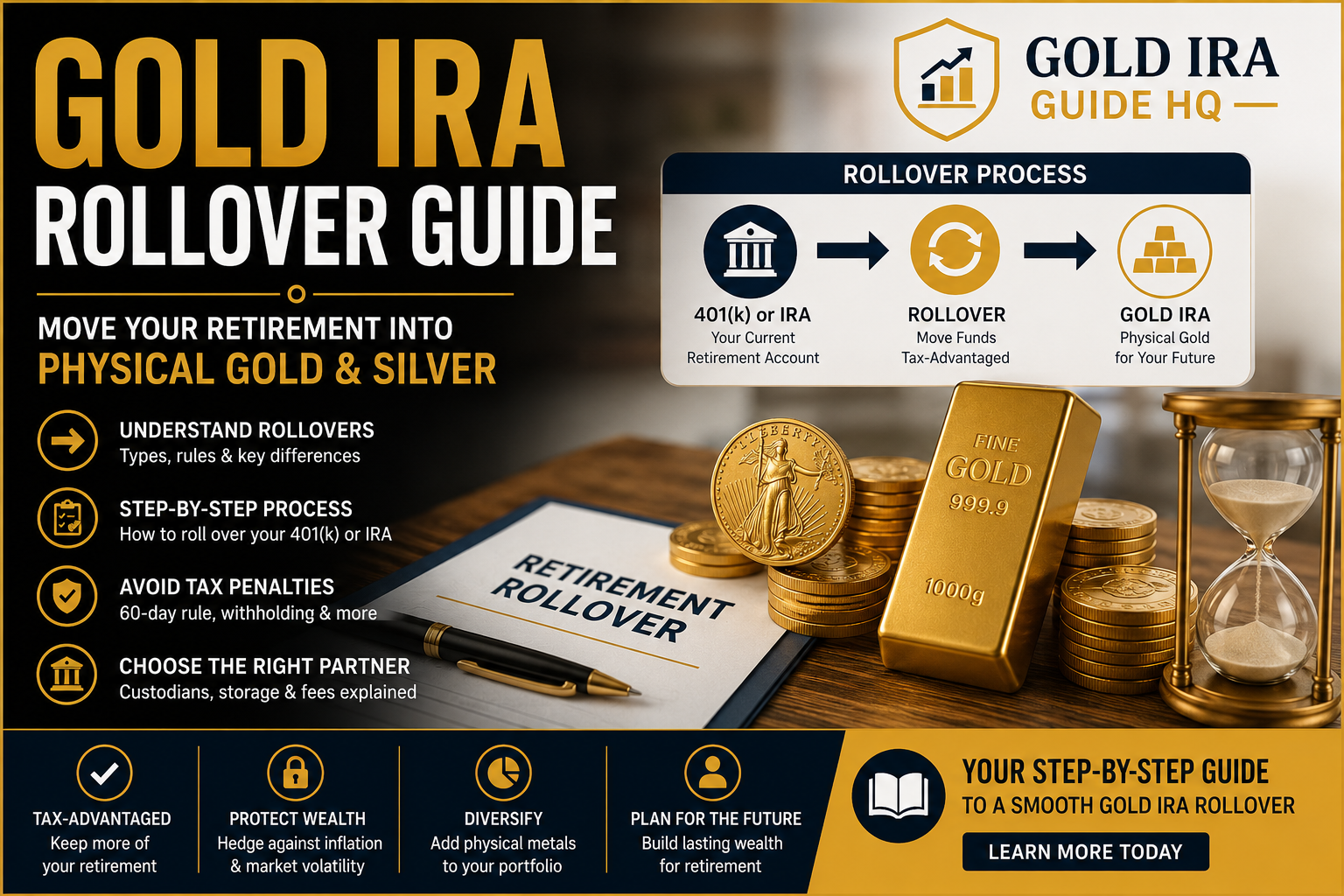
This Gold IRA Rollover Guide explains how eligible retirement assets may be moved into a self-directed IRA that can hold qualifying physical precious metals.
A Gold IRA rollover does not mean withdrawing your retirement savings, buying gold personally, and placing it in a home safe. A properly structured rollover generally involves an eligible retirement distribution or transfer, a self-directed IRA custodian, qualifying precious metals and an appropriate storage arrangement.
The rollover rules matter because mistakes can potentially create taxes, withholding requirements or additional penalties.
Our Gold IRA Rollover Guide covers direct rollovers, trustee-to-trustee transfers, 60-day rollovers, 401(k) eligibility, IRA transfers, tax considerations, required minimum distributions, fees, storage and the exact questions investors should ask before moving funds.
If you are new to precious metals retirement accounts, read our What Is a Gold IRA? guide first.
Gold IRA Rollover Guide: Quick Summary
What Is a Gold IRA Rollover?
A Gold IRA rollover generally refers to moving eligible retirement assets from an existing retirement account or employer plan into a self-directed IRA that will hold qualifying physical precious metals.
The IRS explains that many pre-retirement payments from retirement plans or IRAs can be rolled into another eligible plan or IRA when the applicable rollover rules are followed.
You can review the IRS guidance on retirement-plan and IRA rollovers for the current federal framework.
A key point in this Gold IRA Rollover Guide is that the rollover moves the retirement-account assets into an IRA structure first. The IRA can then purchase qualifying precious metals under the applicable account, custody and eligibility rules.
Gold IRA Rollover Guide: Direct vs Indirect Rollovers
There are several ways retirement assets can move between accounts, and the terminology matters.
| Method | How It Works | Key Consideration |
|---|---|---|
| Direct Rollover | An employer retirement plan sends an eligible distribution directly to the receiving IRA or plan. | Mandatory 20% withholding generally does not apply. |
| Trustee-to-Trustee Transfer | An IRA financial institution transfers assets directly to another IRA trustee or custodian. | The funds generally do not pass through your personal hands. |
| 60-Day Rollover | An eligible distribution is paid to you and you redeposit eligible amounts into another retirement account within the applicable period. | Additional withholding and deadline risks can apply. |
Direct Rollover
If an eligible distribution is coming from an employer-sponsored retirement plan, you may be able to instruct the plan administrator to send the funds directly to the receiving IRA.
According to the IRS, no tax is withheld from an eligible amount transferred through a direct rollover.
For many investors, a direct rollover can reduce the risk of accidentally missing the 60-day deadline or having to replace withholding from personal funds.
Trustee-to-Trustee Transfer
When funds move directly from one IRA trustee to another IRA trustee, the IRS describes the transaction as a trustee-to-trustee transfer.
This is particularly relevant when moving assets from an existing IRA into a self-directed IRA.
The IRS also notes that direct trustee-to-trustee IRA transfers are not subject to the one-rollover-per-year limitation that applies to certain IRA-to-IRA 60-day rollovers.
60-Day Rollover
A 60-day rollover occurs when an eligible retirement distribution is paid to you personally and you then deposit eligible amounts into another qualifying retirement plan or IRA.
This method requires greater care.
The IRS generally requires the rollover to be completed within 60 days after you receive the distribution, although limited waiver provisions can apply in certain circumstances.
Gold IRA Rollover Guide: The 20% Withholding Rule
One of the most important tax rules in this Gold IRA Rollover Guide involves mandatory withholding on certain employer-plan distributions.
The IRS states that an eligible taxable retirement-plan distribution paid directly to you is generally subject to 20% mandatory federal income-tax withholding.
Suppose an investor requests a $100,000 eligible 401(k) distribution payable directly to themselves.
If 20% is withheld, the investor may receive $80,000 while $20,000 is sent for federal tax withholding.
If the investor wants to roll over the entire $100,000 within the applicable 60-day period, the IRS explains that the withheld portion generally has to be replaced using money from another source.
A direct rollover avoids this mandatory 20% withholding requirement on the transferred amount.
Gold IRA Rollover Guide: Step-by-Step Process
The exact process differs according to your current retirement account, plan administrator, custodian and precious metals provider.
However, this Gold IRA Rollover Guide can be summarized in six general steps.
Determine Whether Your Existing Retirement Assets Are Eligible
Start by identifying the type of account you currently hold.
Examples may include a traditional IRA, 401(k), 403(b) or another eligible retirement plan.
Employer-plan distributions must satisfy the plan’s own conditions before funds can be distributed. For example, termination of employment is one common event that may allow distribution, although specific plan rules differ.
Choose a Self-Directed IRA Custodian
A Gold IRA requires an appropriate IRA trustee or custodian capable of administering the self-directed account and the assets you intend to hold.
Compare custodial fees, reporting, service and available depositories before opening the account.
Open the Receiving Gold IRA
Complete the account-opening documents before initiating the rollover.
Having the destination account established first can make the transfer process easier to coordinate.
Request the Rollover or Transfer
Contact your existing plan administrator or IRA provider and request the appropriate rollover or trustee-to-trustee transfer paperwork.
Where possible, carefully consider whether a direct rollover is preferable to receiving funds personally.
Select Eligible Precious Metals
Once eligible rollover assets reach the self-directed IRA, you can choose qualifying precious metals available through the account.
Not every gold or silver coin qualifies for IRA ownership, so product eligibility should be confirmed before purchase.
Arrange Appropriate Storage
Physical precious metals held inside the IRA must follow applicable custody and storage requirements.
Review the available depositories, annual storage fees, insurance arrangements and account procedures before completing the purchase.
Research Gold IRA Rollovers Before Moving Retirement Savings
Augusta Precious Metals offers a free educational Gold IRA guide covering rollovers, precious metals and questions investors may want to consider before opening an account.
Affiliate links • Free educational resources
Can You Roll a 401(k) Into a Gold IRA?
Yes, certain eligible 401(k) distributions may potentially be rolled into an IRA that holds qualifying precious metals.
However, your ability to take a distribution from the 401(k) depends on the terms of the plan and whether a distribution event has occurred.
The IRS notes that retirement-plan distributions must meet the plan’s conditions for distribution.
This is why a Gold IRA Rollover Guide should distinguish between former-employer and current-employer plans.
Former-Employer 401(k)
A 401(k) from a previous employer may often present more rollover options because employment with the plan sponsor has ended.
Investors should still verify the plan’s distribution rules before assuming the entire account can be rolled over.
Current-Employer 401(k)
A current employer’s plan may restrict distributions while you remain employed.
Some plans may allow certain in-service distributions, while others may not.
Contact the plan administrator to determine what options are actually available.
For a broader account comparison, read our Gold IRA vs 401(k) guide.
Can You Roll an IRA Into a Gold IRA?
An existing IRA may also potentially be moved to a self-directed IRA.
In many cases, a direct trustee-to-trustee transfer can move IRA assets from the current financial institution to the new IRA custodian.
This is different from receiving the IRA distribution personally and completing a 60-day rollover.
A particularly important rule in this Gold IRA Rollover Guide is that the IRS one-rollover-per-year limitation applies to certain IRA-to-IRA rollovers where you receive the distribution.
The one-per-year rule does not apply to direct trustee-to-trustee IRA transfers. It also does not apply to plan-to-IRA rollovers.
Gold IRA Rollover Guide: Which Distributions Cannot Be Rolled Over?
Not every retirement-plan distribution qualifies for rollover treatment.
The IRS identifies several categories that generally are not eligible rollover distributions.
Examples include:
- Required minimum distributions
- Certain hardship distributions
- Certain distributions of excess contributions and related earnings
- Certain substantially equal periodic payments
- Certain loans treated as deemed distributions
- Certain other plan-specific distributions
The IRS rollover tax guidance provides additional details regarding eligible and ineligible distributions.
Gold IRA Rollover Guide: Traditional IRA vs Roth IRA
Tax treatment can differ significantly depending on the type of account receiving the rollover.
Moving eligible pretax retirement assets to a traditional IRA can generally preserve tax-deferred treatment when rollover rules are properly followed.
Moving pretax retirement assets into a Roth IRA is different because the transaction may constitute a Roth conversion and can generally create taxable income.
Therefore, a Gold IRA Rollover Guide should never assume all Gold IRA rollovers are automatically tax-free.
The result depends on the source account, destination account, tax character of the assets and how the transaction is structured.
Does a Gold IRA Rollover Count Toward the Annual IRA Contribution Limit?
An eligible rollover contribution is different from a regular annual IRA contribution.
For 2026, the general IRA contribution limit is $7,500, or $8,600 for eligible individuals age 50 or older.
However, eligible rollover contributions are not counted toward that normal annual contribution limit.
This means a qualifying rollover can potentially involve significantly more than $7,500 when an investor is moving an eligible existing retirement balance.
This distinction is essential to any accurate Gold IRA Rollover Guide.
How Long Does a Gold IRA Rollover Take?
There is no universal processing time because several institutions may be involved.
The timeline can depend on:
- Your existing plan administrator
- The new IRA custodian
- Whether paperwork is completed electronically or by mail
- Whether checks must be issued
- Identity-verification requirements
- Whether additional documentation is required
Do not confuse administrative processing time with the IRS 60-day rollover rule.
The 60-day rule concerns eligible distributions that are paid directly to you and then rolled into another eligible retirement arrangement.
A direct rollover is handled differently because the assets move directly between eligible retirement arrangements.
Gold IRA Rollover Guide: Fees to Consider
A rollover itself is only one part of the total cost.
After the self-directed IRA is established, physical precious metals can involve costs that ordinary brokerage retirement accounts may not have.
| Potential Cost | What to Ask |
|---|---|
| IRA Setup | Is there a one-time account-establishment fee? |
| Custodian Fee | What annual administration charges apply? |
| Storage | How much does the depository charge each year? |
| Insurance | Is insurance included in the storage price? |
| Dealer Spread | What is the difference between purchase and potential resale pricing? |
| Transactions | Are purchases, sales or distributions subject to additional charges? |
This Gold IRA Rollover Guide recommends comparing the full cost of ownership, not simply one advertised annual fee.
Our Best Gold IRA Companies page can help you compare different providers before deciding.
Gold IRA Rollover Guide: Choosing a Gold IRA Company
The precious metals company can affect education, product selection, pricing and the overall experience of completing the rollover.
Before choosing a company, review:
- Minimum investment requirement
- Company history
- Available metals
- Dealer spreads
- Custodian relationships
- Storage choices
- Buyback procedures
- Educational resources
- Customer support
- Written fee disclosures
You can also read our Augusta Precious Metals Review and Augusta vs Noble Gold comparison for examples of the factors we evaluate.
Gold IRA Rollover Guide: Common Mistakes to Avoid
Rollover mistakes can be more serious than ordinary investment-selection mistakes because they can involve retirement-account tax rules.
1. Automatically Requesting a Check Payable to Yourself
Receiving an employer-plan distribution personally can trigger mandatory withholding rules. A direct rollover may avoid that withholding on the transferred amount.
2. Missing the 60-Day Deadline
If you receive an eligible distribution personally and intend to roll it over, failing to complete the rollover within the applicable period may cause some or all of the distribution to become taxable unless an available waiver applies.
3. Forgetting About Withholding
If an eligible employer-plan distribution is paid to you and 20% is withheld, rolling over only the amount received may leave the withheld amount treated differently for tax purposes.
4. Trying to Roll Over an RMD
Required minimum distributions are generally not eligible for rollover.
5. Buying Metals Before Confirming IRA Eligibility
Not every gold or silver product is eligible to be held in an IRA.
6. Ignoring Dealer Spreads
A company can advertise low annual account fees while charging significantly different purchase and resale prices for precious metals.
7. Moving Too Much of a Retirement Portfolio Into One Asset
A Gold IRA can provide precious-metals exposure, but concentrating retirement assets in one asset class can create additional risk.
Gold IRA Rollover Guide: Pros and Cons
Potential Advantages
- Allows eligible retirement assets to remain within a retirement-account structure
- Can provide exposure to qualifying physical precious metals
- May increase diversification beyond stocks and bonds
- Direct rollovers can avoid mandatory withholding on eligible transferred plan amounts
- Can consolidate certain former-employer retirement assets into an IRA
Potential Drawbacks
- Physical precious metals involve custodian and storage costs
- Dealer spreads can reduce returns
- Gold prices can decline
- Physical metals do not generate dividends or interest
- Incorrectly handled rollovers can create tax complications
- A Gold IRA may not be appropriate for every retirement investor
Should You Roll Your Entire 401(k) Into Gold?
There is no general rule saying an investor should move an entire retirement account into gold.
A rollover does not have to be viewed as an all-or-nothing decision.
An investor’s appropriate allocation depends on factors such as overall retirement assets, age, risk tolerance, income needs, investment horizon and existing diversification.
This Gold IRA Rollover Guide therefore does not recommend automatically moving 100% of retirement savings into physical precious metals.
Gold can potentially play a diversification role, but it does not provide guaranteed returns and it does not generate dividends or interest.
Gold IRA Rollover Guide: Who May Consider a Rollover?
A rollover may deserve further research if you:
- Have eligible retirement assets available for rollover.
- Want physical precious-metals exposure within an IRA structure.
- Already have substantial conventional retirement investments.
- Understand the costs of physical precious metals ownership.
- Are willing to use an appropriate custodian and storage arrangement.
- Understand that gold prices can rise or fall.
Who May Not Need a Gold IRA Rollover?
A Gold IRA rollover may be less suitable if you:
- Do not currently have an eligible retirement distribution.
- Need highly liquid investments.
- Want investments that generate dividends or interest.
- Want the lowest possible account costs.
- Do not want additional custodian and storage arrangements.
- Are considering gold because you expect guaranteed profits.
Compare Gold IRA Companies Before Starting a Rollover
Use Augusta’s free company-comparison checklist to review fees, storage, education and other important questions before choosing a Gold IRA provider.
Affiliate disclosure: Gold IRA Guide HQ may receive compensation if you use these links.
Gold IRA Rollover Guide: 12 Questions to Ask Before Moving Funds
Before starting a rollover, consider asking:
- Is my current retirement distribution eligible for rollover?
- Does my existing employer plan currently allow a distribution?
- Should the transaction be structured as a direct rollover or trustee-to-trustee transfer?
- Will any federal tax withholding apply?
- What custodian will administer the new IRA?
- What one-time account setup fees apply?
- What annual custodian fee will I pay?
- Which depositories are available?
- What annual storage fee applies?
- What dealer spread applies to each precious metal?
- How does the company’s future buyback process work?
- How much of my retirement portfolio do I actually want exposed to physical precious metals?
Gold IRA Rollover Guide: Final Verdict
A properly structured Gold IRA rollover can allow eligible retirement assets to move into a self-directed IRA that holds qualifying physical precious metals.
However, the process needs to be understood before funds are moved.
The most important lesson from this Gold IRA Rollover Guide is that a direct rollover, trustee-to-trustee transfer and 60-day rollover are different transactions with different administrative and tax considerations.
Where appropriate, direct movement between retirement institutions can simplify the process and reduce certain withholding and timing risks.
Investors should also confirm that the retirement distribution is eligible for rollover. Required minimum distributions and certain other distributions cannot simply be rolled into a new IRA.
Once the funds reach the self-directed IRA, the investor still needs to evaluate precious metals pricing, custodian fees, storage costs, eligible products and portfolio allocation.
A Gold IRA rollover is therefore not simply a paperwork decision. It is also an investment decision.
Before proceeding, compare multiple companies, understand the complete cost structure and consider whether physical precious metals fit within your broader retirement strategy.
You can continue with our Best Gold IRA Companies guide or browse additional Gold IRA Guides.